About GEO Audit Tool
The GEO Audit by ToolsPivot, also known as an AI SEO Audit, is a free Generative Engine Optimization checker that measures whether ChatGPT, Perplexity, Claude, Gemini, and Google AI Overviews can read, extract, and cite your website. It crawls up to 25 pages, scores against 9 research-grounded pillars, and runs a live AI citation test that actually asks a model whether it would cite your site. Most GEO and AI SEO audit tools stop at robots.txt and schema. This one tells you your Share of Voice against real competing domains.
What This Free AI SEO Audit Tool Does
The GEO Audit is a multi-page generative engine optimization scanner and AI visibility checker that diagnoses why AI search engines aren't citing your content. It works on the URL you submit, follows internal links to discover up to 25 pages, and runs every page through the same 9-pillar scoring engine. The headline output is a 0–100 GEO score and an A–F grade, but the value sits underneath that number: per-page block citability scores, AI-bot access status for every major crawler, brand entity verification against Wikidata, and a live AI test that returns the questions real users ask about your topic.
Who uses this: SEO leads who need to brief executives on AI search exposure, content teams diagnosing why traffic is shifting toward zero-click answers, agencies pitching GEO retainers, and founders checking whether their brand is "technically invisible" to large language models. The free tier needs no signup and no API key.
The problem it fixes: A page can rank #3 in Google and still get zero citations in AI Overviews because the content isn't structured for extraction, the AI bots are blocked, or the brand has no entity footprint. Traditional audits don't catch this. The AI SEO Audit isolates the exact technical and content gaps that keep your URL out of AI answers, then ranks fixes by impact and effort so you know what to ship first. If you've already run our Website SEO Checker and are now thinking about AI visibility, this is the next step.
Why Use This AI Visibility Checker
- Diagnoses AI invisibility in one scan. You learn within 60 seconds whether GPTBot, ClaudeBot, PerplexityBot, and Google-Extended are blocked, allowed, or silently throttled by your robots.txt.
- Quantifies citation likelihood. The live AI test returns a yes/no on whether your domain would realistically be cited for your own topic, plus the competing domains that won the citation slot.
- Replaces guesswork with a Share of Voice number. You see what percentage of AI citations your domain captures versus competitors for the topic the page targets.
- Scores up to 25 pages, not one. Most free GEO tools audit a single URL. ToolsPivot crawls a real site sample so the score reflects your actual content estate.
- Surfaces the highest-impact fixes first. Findings carry severity and effort labels, so a one-hour robots.txt fix isn't buried under a six-week content rewrite.
- Tracks progress over time. Score history records every audit, so you can show your client or stakeholders exactly how each shipped fix moved the needle.
- Verifies your brand as an entity. A Wikidata lookup confirms whether AI models recognize your brand as a distinct thing, not a string of characters, and complements signals from tools like our Backlink Checker on the off-page side.
- Free with no signup. The static audit runs without an account or API key. The live AI layer activates when keys are configured.
Core Features
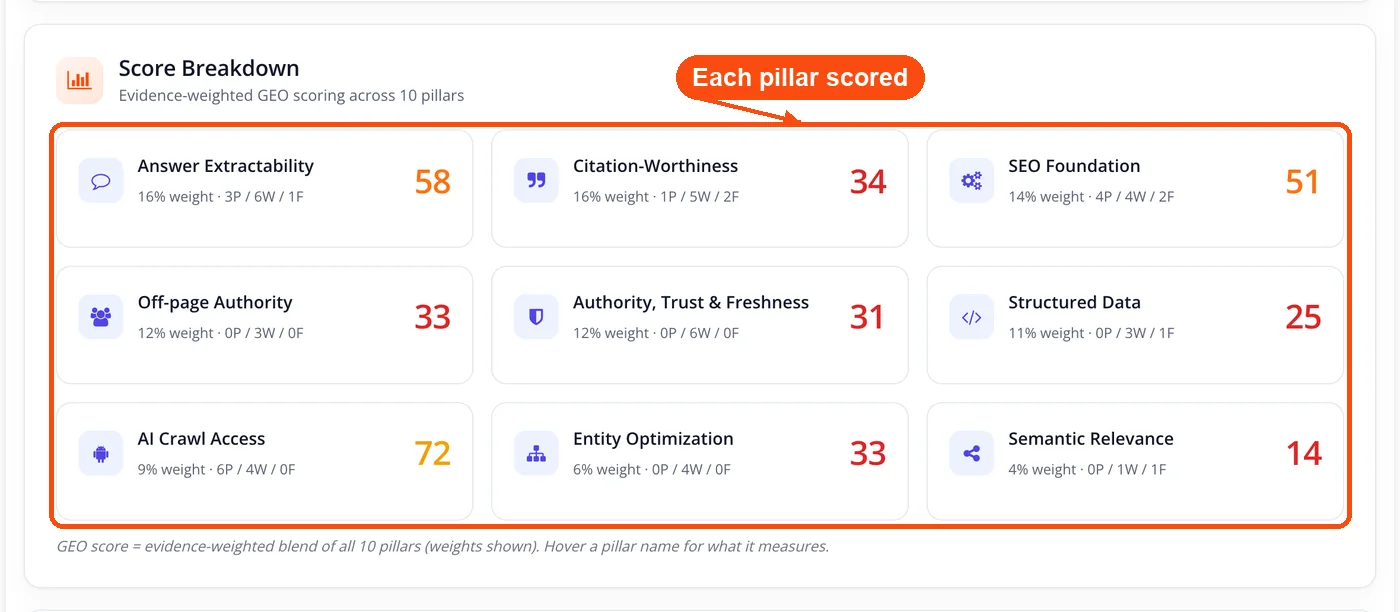
- 9-pillar weighted scoring engine. Answer Extractability (16%), Citation-Worthiness (16%), SEO Foundation (14%), Off-Page Authority (12%), Authority, Trust & Freshness (12%), Structured Data (11%), AI Crawl Access (9%), Entity Optimization (6%), and Semantic Relevance (4%).
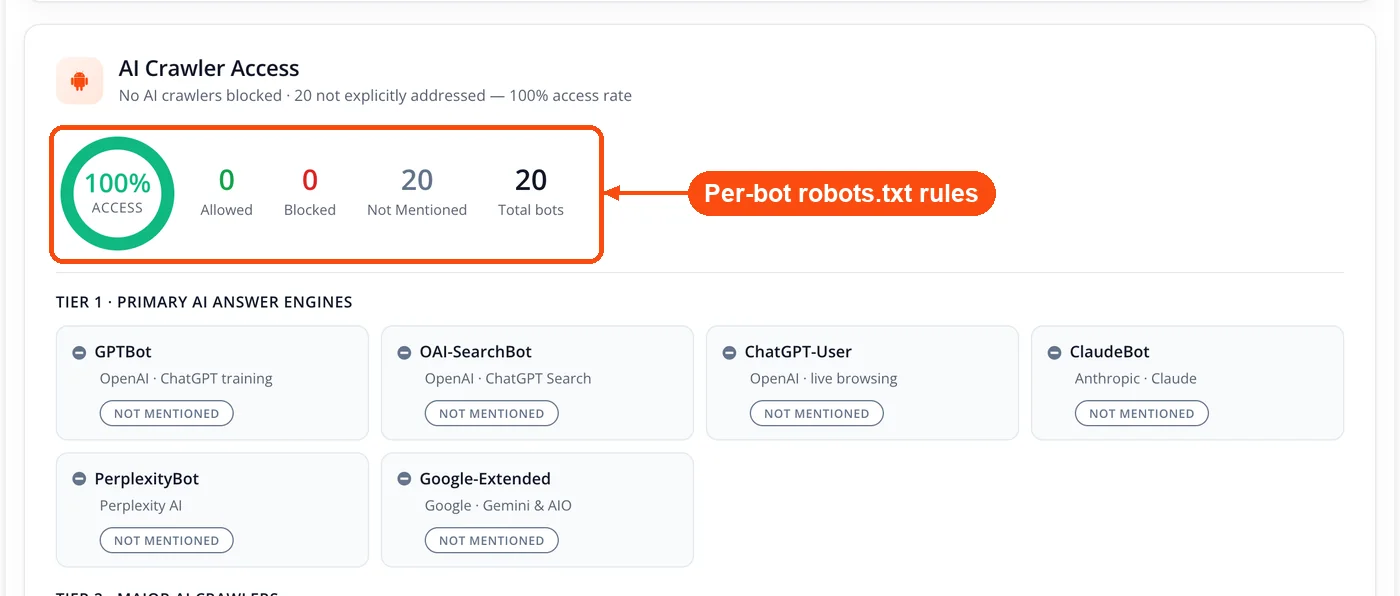
- Per-bot crawler access check. Tests GPTBot, OAI-SearchBot, ChatGPT-User, ClaudeBot, PerplexityBot, Google-Extended, CCBot, and others separately, because one of those bots being blocked is often the entire reason a brand can't be cited.
- Live AI citation test. Prompts a model behaving like ChatGPT Search or Perplexity, then parses structured JSON for the sources it would cite, your inclusion status, and 8 related questions users actually ask (query fan-out).
- Share of Voice calculation. Computes your domain's percentage of citations across the AI's source list for the queried topic.
- Wikidata entity lookup. Auto-checks whether your brand has a Wikidata Q-number, the strongest entity signal AI engines use to confirm identity.
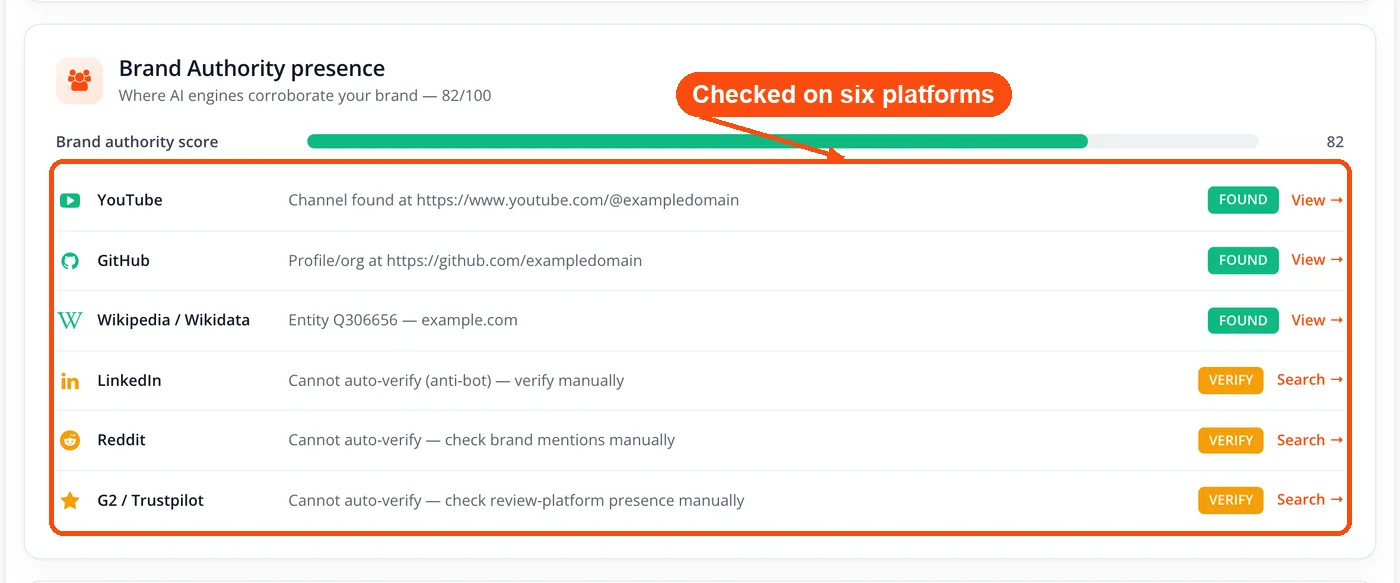
- Multi-platform brand presence. YouTube (@handle), GitHub, and Wikipedia are verified automatically; LinkedIn, Reddit, G2, and Trustpilot get targeted recommendations because anti-bot defenses block direct verification.
- Block-level citability scoring. Each paragraph and section is rated on whether an LLM could lift it as a self-contained answer.
- AI-synthesized executive summary. A final LLM pass writes a site-specific summary and ranked key findings, so the report reads like an analyst memo, not a checklist.
- Branded PDF export. Headless Chrome renders the full report with running header, footer, and score chart, ready to send to a client.
- Schema and JSON-LD analysis. Identifies missing FAQ, HowTo, Article, Organization, and Product schema, since structured data correlates with roughly 40% more citations.
- Score history tracking. Each audit is stored and charted, so you can prove fixes worked rather than asserting it.
- 6-hour result cache. Heavy crawls are batched as background jobs and cached, so you don't hit a request wall on large sites.
How the GEO Audit Works
- Submit your URL. Paste the page or homepage you want audited into the ToolsPivot AI SEO Audit input field.

- Discovery crawl. The tool fetches the URL, follows internal links, and builds a page model for up to 25 pages, collecting titles, headings, schema, and content blocks for each.
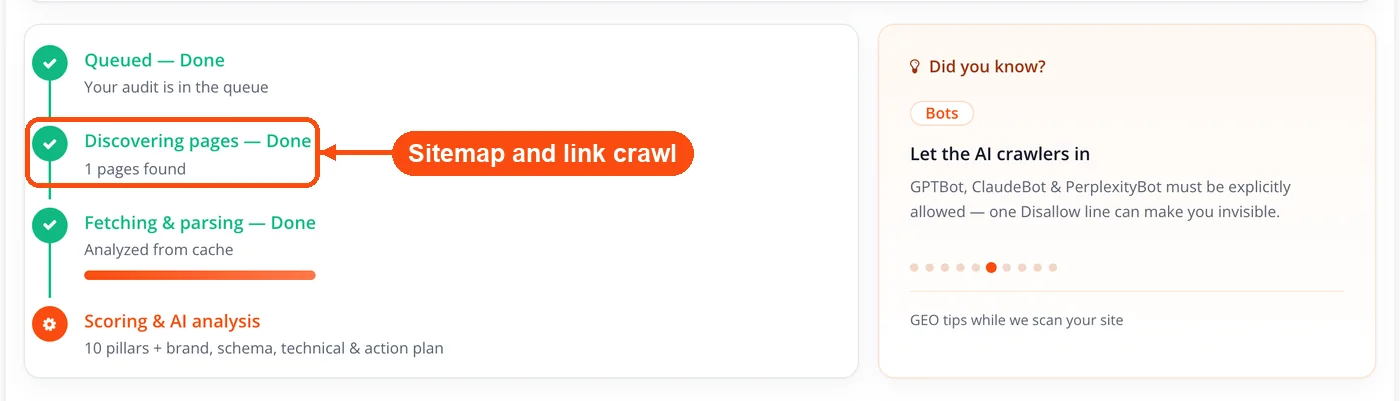
- Site-file probes. Robots.txt, sitemap.xml, llms.txt, and the access rules for 20 AI crawlers are pulled in parallel. If your robots.txt is misconfigured or your XML sitemap is missing key URLs, this is where it surfaces.
- Pillar scoring. Every page is evaluated against all 9 GEO pillars. Pass, warn, and fail flags are assigned at the check level.
- Brand and entity layer. YouTube, GitHub, and Wikipedia / Wikidata are checked automatically, and LinkedIn, Reddit, and review sites are flagged for a manual check. The tool also runs a PageSpeed Insights pass for Core Web Vitals.
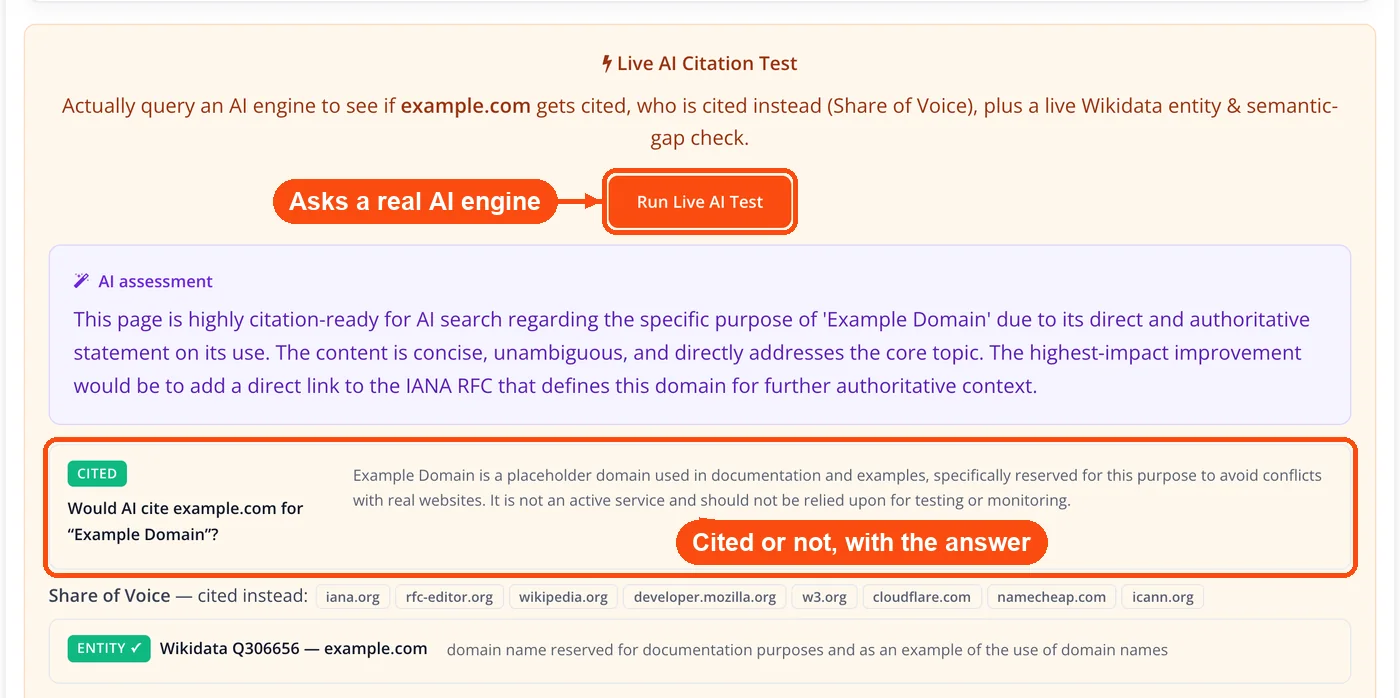
- Live AI test and synthesis. A final AI pass writes your executive summary. Click Run Live AI Test to query a model with a ChatGPT-Search-style prompt: it shows whether the model would cite you, which sites it cites instead, your Wikidata entity, and the questions your page doesn't answer.
When to Use the AI SEO Audit
Run a GEO audit when AI search is starting to siphon traffic that used to land on you from Google. The clearest signal is a flat or declining click-through rate in Search Console on queries where AI Overviews now appear. If your impressions are holding but clicks are dropping, the AI answer above the blue links is keeping users from scrolling.
Specific scenarios where this audit pays off:
- Before launching an AEO or GEO content sprint. Audit first so your sprint targets the actual blockers, not assumptions.
- After a CMS migration. Migrations frequently break schema and reintroduce AI-bot disallows. Catch it in week one, not month six.
- When a competitor starts appearing in AI Overviews. Use Share of Voice to see exactly who's winning your citation slot and what they have that you don't.
- During a quarterly SEO review. A standing GEO score gives you a defensible metric beyond "rankings went up."
- For client pitches. A red GEO score on a prospect's site is a more concrete sales artifact than "your AI visibility is weak."
- After publishing a flagship article. Confirm the new page is block-citable, schema-tagged, and AI-readable before promoting it.
The audit is most useful for informational and commercial-investigation pages, where AI answers are aggressive. It's less critical for transactional pages where users still click rather than ask.
Use Cases
Recovering Lost Informational Traffic
Context: A SaaS blog notices a 35% drop in organic clicks on top-of-funnel comparison posts since AI Overviews rolled out for their category. Process:
- Audit the affected URLs through the AI SEO Audit and check block citability per page.
- Cross-reference AI crawler access in robots.txt and add explicit allow rules.
- Rebuild paragraph structure so the first sentence of each section answers the H2. Result: Citations begin appearing within two crawl cycles, and click-through stabilizes as users still convert from the cited snippet.
Diagnosing a Newly Published Page
Context: A content team ships a 3,000-word definitive guide that ranks page two but never appears in AI answers. Process:
- Submit the URL and review the Citation-Worthiness pillar specifically.
- Add direct quotes, named statistics, and authority citations the pillar flagged as missing.
- Verify originality with an AI Content Detector pass and confirm schema validates without JavaScript. Result: The page enters the AI source list within a refresh cycle and starts driving brand-trust referrals.
Pre-Migration QA
Context: A media site is moving from a legacy CMS to a headless setup before a Black Friday content push. Process:
- Run the audit on the staging build to capture a baseline GEO score.
- Use the per-bot crawler check to confirm staging blocks haven't shipped to production.
- Validate that schema and canonical tags survived the migration on a 25-page sample. Result: The team launches with an equal or higher GEO score than pre-migration and avoids the typical post-migration AI-visibility crash.
Agency Client Onboarding
Context: A boutique SEO agency wants a defensible GEO baseline before signing a six-month retainer. Process:
- Audit the prospect's site and export the branded PDF report.
- Use the AI-synthesized executive summary as the first slide of the proposal.
- Quote Share of Voice against the three competitors the AI cited instead. Result: The proposal moves from "trust us" to "here is your number," and close rate improves on technical-SEO-aware buyers.
Founder-Led Brand Visibility Check
Context: A bootstrapped founder wants to know whether ChatGPT cites their company when asked "best [their category] tools." Process:
- Run the audit on the homepage and the top three commercial pages.
- Review the Wikidata entity check and Off-Page Authority pillar.
- Build out missing platform presence on the recommended channels (YouTube handle, GitHub org, Wikipedia stub). Result: The founder leaves with a 30-day brand-authority checklist rather than a vague "build more content" recommendation.
Understanding Your GEO Score
The overall score is a weighted average of the 9 pillars, mapped to a letter grade: A is 90+, B is 80–89, C is 70–79, D is 60–69, and F is below 60. The grade is a quick signal for stakeholders. The pillar breakdown is where the actual diagnosis lives.
A score in the 60s with a strong SEO Foundation pillar but a weak Answer Extractability and Citation-Worthiness pillar tells a specific story: your site ranks fine, but AI engines can't lift clean answers from it. That's a content-structure problem, not a technical one, and the fix is paragraph rewrites rather than schema work.
A score in the 70s with a strong content profile but a failing AI Crawl Access pillar tells a different story entirely: your content is citable, but the bots can't reach it. That's a one-line robots.txt fix, and the score jumps the next time you audit. Read the pillars before you act on the number.
The 9 GEO Pillars, in Plain English
Each pillar carries a weight calibrated against published GEO citation research and ToolsPivot's own observed correlations. The weights aren't arbitrary, they reflect which signals move the citation needle most.
- Answer Extractability (16%). Can a model lift a clean, self-contained answer out of any paragraph? Princeton's GEO research identifies this as the single largest lever.
- Citation-Worthiness (16%). Do you give the model reasons to cite you? Statistics, direct quotes, and named authorities drive this score.
- SEO Foundation (14%). Indexability and metadata health, because a page Google can't index is a page no AI can find.
- Off-Page Authority (12%). sameAs links, social-platform presence, and external corroboration, since AI models cross-reference sources across the open web.
- Authority, Trust & Freshness (12%). Author bylines, dates, and recency. Content updated in the last 90 days gets cited roughly three times more often than stale pages.
- Structured Data (11%). Your JSON-LD coverage. Schema correlates with about 40% more citations across studied samples.
- AI Crawl Access (9%). Per-bot pass/fail on GPTBot, ClaudeBot, PerplexityBot, Google-Extended, and others. One blocked bot is often the entire reason a brand can't be cited.
- Entity Optimization (6%). Wikidata presence, entity relationships, and how clearly your brand is identifiable as a "thing" rather than a string.
- Semantic Relevance (4%). Topical clustering and internal coverage depth across the crawled pages.
Honest Limitations
The AI SEO Audit is a diagnostic, not a guarantee. A perfect score doesn't mean you will be cited tomorrow, because AI citation also depends on user query phrasing, model version, and competitor activity that's outside any site's control.
A few specific limits worth knowing before you act on the report:
- The live AI test is a snapshot. It returns one model's reasoning at one point in time, so re-running it on different days can yield different competing domains.
- Wikidata can be checked, not created. The entity lookup confirms presence but can't generate a Q-number for you.
- Anti-bot platforms are recommendations, not verifications. LinkedIn, Reddit, G2, and Trustpilot block crawlers, so the tool surfaces what to build rather than confirming what exists.
- The AI layer needs API keys. Static scoring runs free; the live citation test and AI-written summary activate only when keys are configured.
Treat the GEO score as a leading indicator and the per-pillar findings as your work order. If you're also tightening up surface-level fundamentals, pair this with our Index Checker and a fresh meta tag review so the foundational layer is solid before you optimize for AI extraction.
Frequently Asked Questions
A GEO audit checks whether your site can be discovered, read, and cited by generative AI engines like ChatGPT, Perplexity, Claude, Gemini, and Google AI Overviews. It evaluates technical access, content structure, schema, and brand entity signals. The output is a score plus a prioritized list of fixes.
Yes, in practice they refer to the same evaluation. "GEO audit" emphasizes the optimization framework (Generative Engine Optimization); "AI SEO audit" emphasizes the search context (SEO for AI engines). Some tools brand themselves with one term and some with the other, but the checks they run, citation readiness, AI crawler access, schema, entity authority, are functionally identical.
A traditional SEO audit measures ranking factors for the Google blue links: keywords, backlinks, page speed, indexability. A GEO audit measures the signals AI engines use to choose which sources to cite in generated answers, including AI-bot access, block-level citability, and entity authority. The two overlap on technical fundamentals but diverge on content structure and brand presence. Run both audits together if you're rebuilding visibility from the ground up.
Yes. The static audit runs free with no signup and no API key. The live AI citation test and AI-synthesized summary activate when API keys are configured in the backend; static scoring works regardless.
Up to 25 pages per scan. The tool starts from the URL you submit, follows internal links to discover related pages, and de-duplicates URLs before scoring. Larger crawls run as batched background jobs to avoid request limits.
It checks compatibility with ChatGPT Search, Perplexity, Claude, Gemini, Google AI Overviews, and any system that respects GPTBot, OAI-SearchBot, ChatGPT-User, ClaudeBot, PerplexityBot, Google-Extended, and CCBot. The live citation test currently runs through Gemini or an OpenRouter chain configured to behave like ChatGPT Search.
Share of Voice is the percentage of AI-cited sources that point to your domain for a given topic. If the model cites five sources and you appear in two of them, your SoV for that topic is 40%. It's a comparative metric, so it's most useful tracked over time and against named competitors.
The most common cause is a global Disallow: / for an AI-specific user agent in robots.txt, often added by default by hosting platforms or CDNs concerned about training-data scraping. The fix is explicit allow rules for the bots you want to permit, applied at the user-agent level rather than globally.
It helps on the margins. An llms.txt provides a machine-readable summary of your site's purpose and key URLs, which speeds up entity resolution. It's not weighted as heavily as schema or crawler access, but it's cheap to add. Generate one with the llms.txt Generator.
Run a baseline now, re-audit after every major content or technical change, and run a standing audit monthly to catch regressions. The score history view shows the trend across runs, so monthly cadence gives you a clean chart for stakeholder reporting.
It matters less than you'd expect. Roughly 80% of LLM citations point to URLs that don't rank in Google's top 100 for the original query. AI engines weight extractability, schema, and entity signals more than blue-link rankings. Strong SEO is the floor, not the ceiling.
Yes. The tool accepts any public URL. Auditing a competitor is one of the fastest ways to identify why they're being cited and you aren't, especially when paired with the Domain Authority Checker for an authority comparison.
Restructuring the first sentence of every paragraph to directly answer the heading above it. Answer Extractability is the heaviest-weighted pillar, and most pages fail it because they open paragraphs with context instead of answers. It's a content edit, not a technical fix, but it moves the score more than any single schema addition.
No. Google-Extended is a separate user agent from Googlebot. Blocking Google-Extended prevents your content from being used for Gemini training and AI features, but it doesn't affect your standing in Google Search. The trade-off is AI visibility, not search ranking.
The technical layer (crawler access, schema, robots.txt, structured data) works for any language. The live AI citation test and content scoring work best on English content right now. Multi-language scoring is a roadmap item.
