Color Picker Tool
A free color picker that gives you every format at once. Drag the picker or use the eyedropper, then copy HEX, RGB, HSL, HSV, CMYK or the nearest CSS name. Build harmonies, tints and shades, check contrast, and pull colors from an image.
About Color Picker Tool
A color picker is a browser tool that lets you choose any color visually and copy its exact code in the format your project needs. The rebuilt ToolsPivot Color Picker turns one picked color into ten formats at once, from HEX and RGB to modern OKLCH, and folds in the extras designers usually open five separate sites for: a screen eyedropper, color harmonies, tint and shade strips, a WCAG contrast checker, image sampling, and a CSS gradient builder. It runs entirely in your browser, saves nothing to a server, and needs no account.
About the ToolsPivot Color Picker
The Color Picker is a free online color picker and fully client-side color studio for web designers, front-end developers, and anyone who needs precise color codes without design software. You set a color three ways: drag the saturation and value square with the hue and alpha sliders, type a HEX, rgb(), or CSS color name, or sample a pixel with the native eyedropper or from an uploaded image. From that single value the tool derives every output format, so nothing drifts as you drag.
The people who reach for a color picker most are building or matching a palette. A freelance developer translating a brand brief into CSS variables, an e-commerce owner styling a Shopify banner, a UI designer deriving hover and focus states, and a marketer matching one brand color across Canva, Google Slides, and a WordPress page all need the same thing: an exact code they can paste anywhere. This version solves the older problem of jumping between a picker, a converter, and a separate contrast tool by putting the whole chain in one place. Grab a HEX here, drop it straight into the online HTML editor, and skip the manual conversion step entirely.
Color Picker With HEX Code, RGB and More Formats
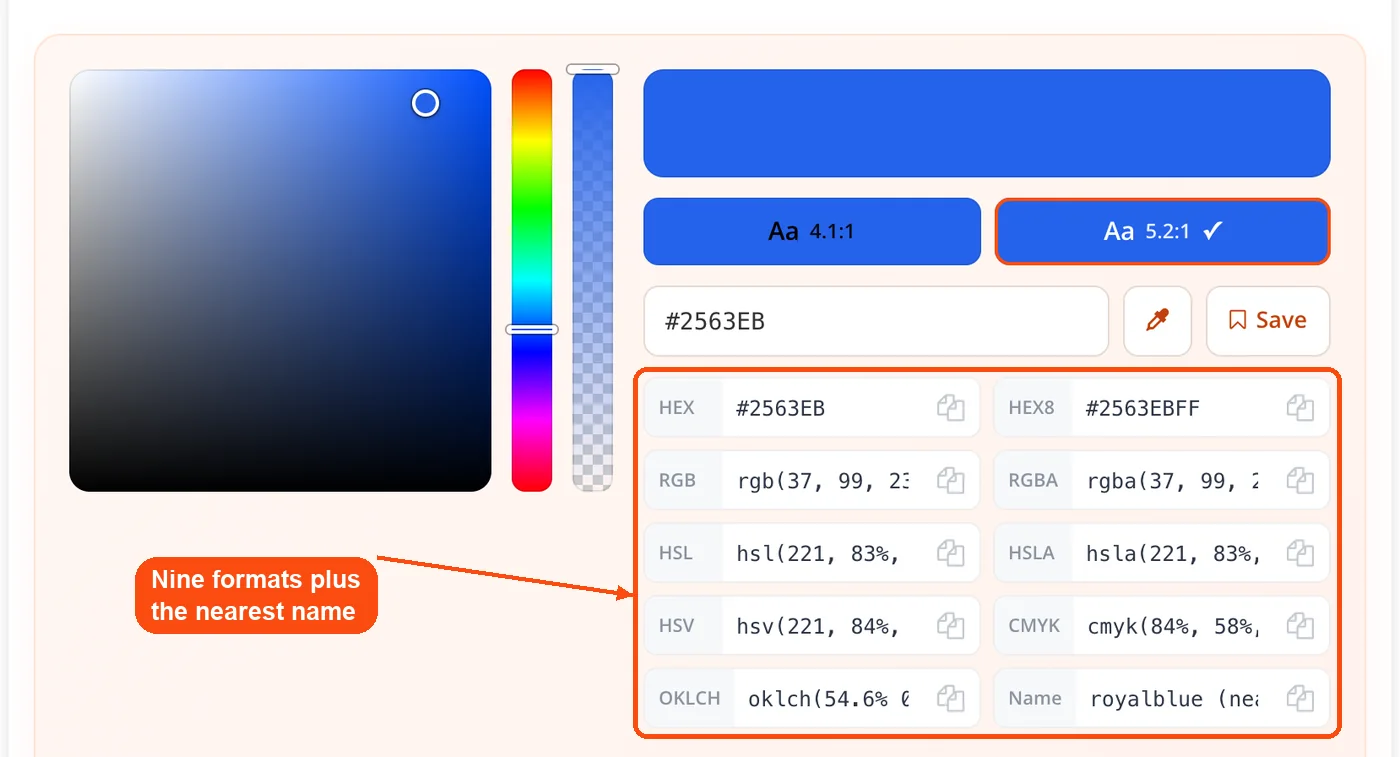
The Color Picker outputs ten formats from a single pick, each with a one-click copy button. The older version showed three (HEX, RGB, HSL); the rebuild adds HSV, CMYK, perceptually-even OKLCH, alpha variants, and the nearest CSS named color. Every value is derived from one high-precision internal color, so what you copy matches what the browser renders.
| Format | What it is | Example |
|---|---|---|
| HEX / HEX8 | Web standard, plus alpha | #3498DB / #3498DBFF |
| RGB / RGBA | Screen channels, 0 to 255 | rgb(52, 152, 219) |
| HSL / HSLA | Human-friendly hue, saturation, lightness | hsl(204, 70%, 53%) |
| HSV | Hue, saturation, value | hsv(204, 76%, 86%) |
| CMYK | Print approximation from sRGB | cmyk(76%, 31%, 0%, 14%) |
| OKLCH | Perceptually-even modern CSS | oklch(65.3% 0.135 242.7) |
| Named | Nearest CSS keyword | steelblue (nearest) |
Key Benefits
- Ten formats, one pick. Copy HEX, RGB, HSL, HSV, CMYK, or OKLCH from the same color without opening a second converter or doing manual math.
- No color drift. Because every format comes from one internal high-precision value, dragging the picker never introduces the rounding errors that plague HEX-to-HSL round trips.
- Accessibility built in. The WCAG contrast checker gives you an AA and AAA pass or fail on the spot, so you don't need a separate accessibility tool to sign off on text readability.
- Sample from anywhere. The screen eyedropper lets you pick a color on screen from any window, and image sampling pulls exact colors and a dominant palette out of a photo, logo, or screenshot.
- Nothing leaves your device. All color math runs in the browser with no upload and no server request, which keeps client mockups and unreleased brand assets private.
- Free and account-free. Pick, save, and copy as much as you want with no sign-up and no usage caps, in any of 18 languages.
Core Features
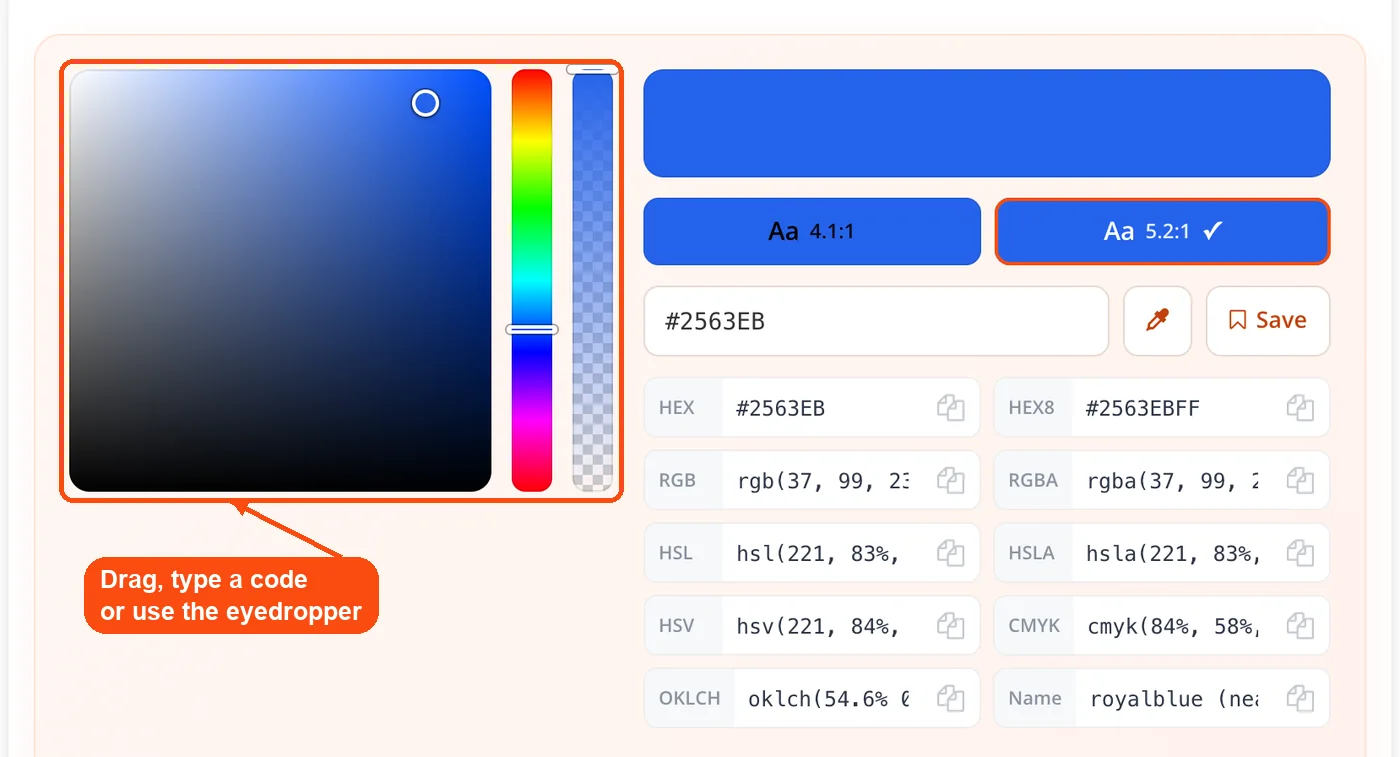
- Saturation and value square. Drag the marker across the field to set shade, and move the hue slider to change the base color, with live preview as you go.
- Alpha slider. Set transparency from fully opaque to clear, and the output switches to 8-digit HEX, RGBA, and HSLA automatically.
- Screen eyedropper. The native EyeDropper lets you click any pixel on your screen, even outside the browser, in supported browsers.
- Direct code input. Type a HEX,
rgb()value, or CSS color name and the picker loads it and fills in every other format instantly. - Ten-format grid. Each format sits in a copyable tile, so you grab exactly the notation your CSS, JavaScript, or design tool expects.
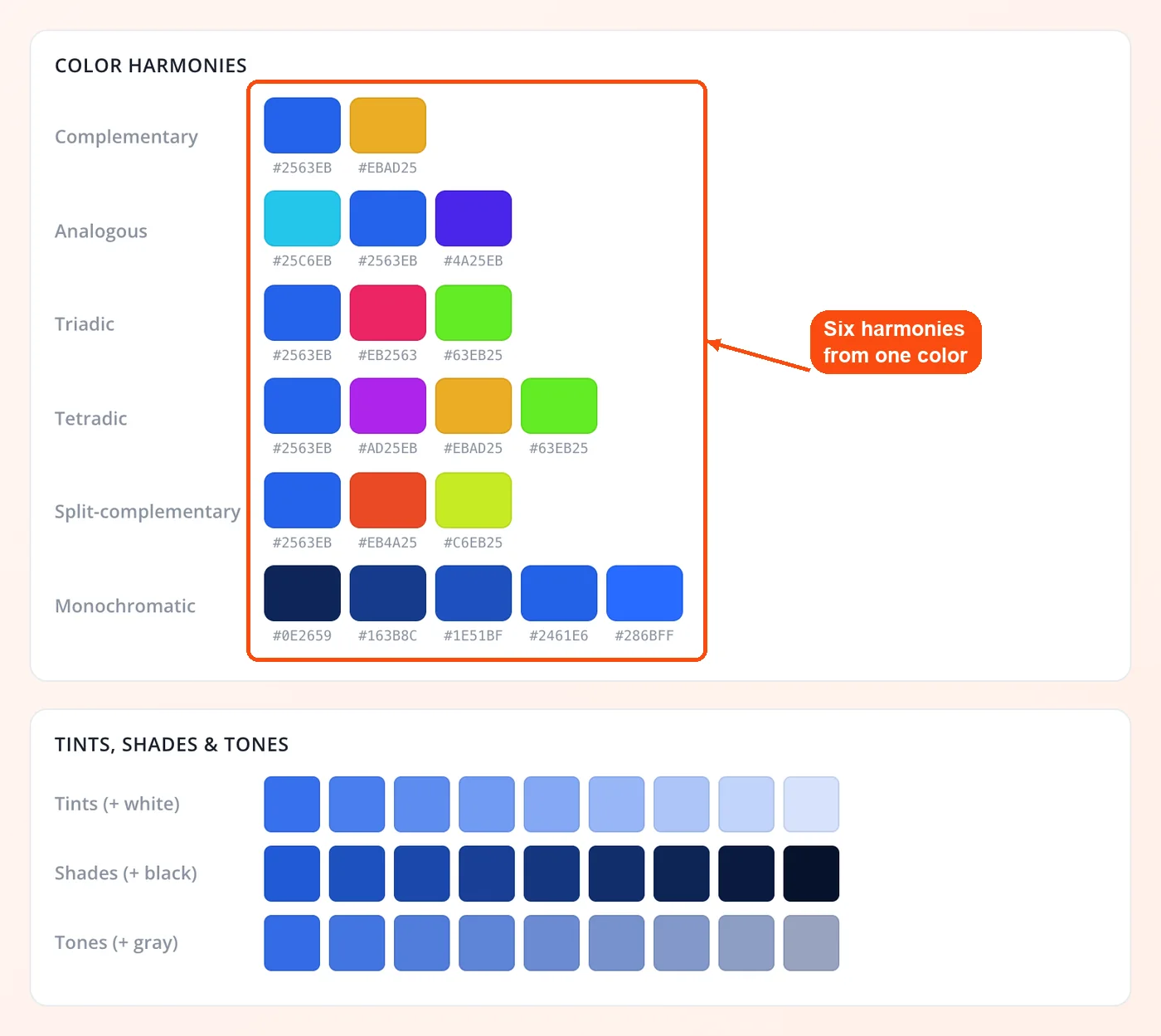
- Color harmonies. Generate complementary, analogous, triadic, tetradic, split-complementary, and monochromatic schemes by rotating hue from your base color.
- Tints, shades, and tones. Three variation strips step lightness and saturation so you get lighter, darker, and muted versions of one color at a glance.
- WCAG contrast checker. Drop in two colors to see the ratio and a pass or fail for AA, AA Large, and AAA text.
- HEX color picker from image. Use it as an image or photo color picker: upload a photo or screenshot, click any pixel to get its HEX code, and get an automatic dominant-color palette.
- CSS gradient builder. Add a second color, set the angle, choose linear or radial, and copy ready CSS.
- Readability preview. Live black-and-white text samples show how legible your color is behind copy before you commit.
- Saved colors. Colors persist between visits in your browser, so a palette you started yesterday is still there today.
How ToolsPivot Color Picker Works
- Set your color. Drag the saturation and value square with the hue slider, type a code, or click the eyedropper to sample a pixel from your screen.
- Read every format. The picker converts your color to nine notations at once, from HEX to OKLCH, plus the nearest named color.
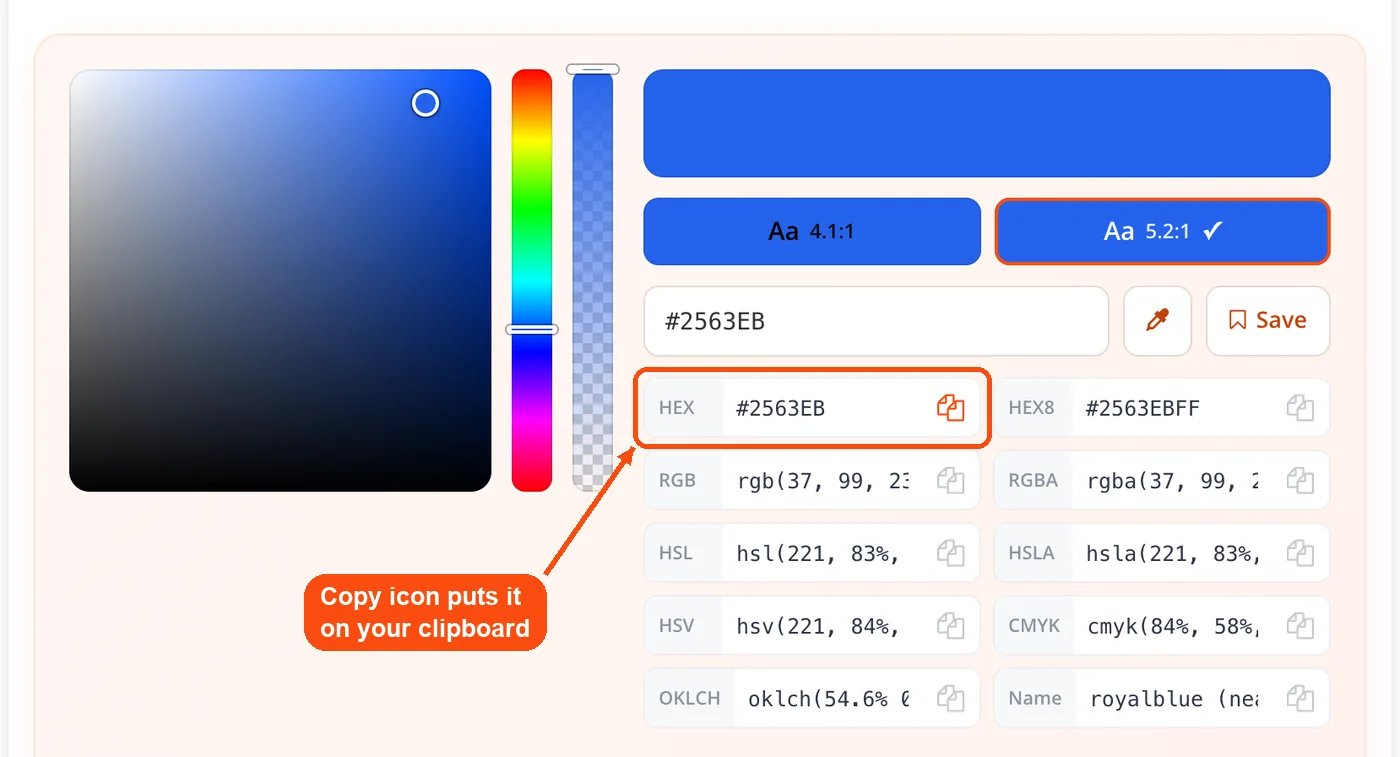
- Copy what you need. Click the copy icon on any format tile to send that value straight to your clipboard, ready to paste.
- Build variations. Generate harmonies, tint and shade strips, or a gradient, and check a pairing in the contrast checker.
- Save and reuse. Add colors to your saved set, which stays in your browser between sessions.

When to Use the Color Picker
Reach for the Color Picker whenever you need an exact color value rather than an eyeballed guess. It fits both the visual exploration stage of a new project and the precise, code-ready stage near handoff.
- Translating a brand brief. Turn a vague "modern blue" into a locked HEX and its RGB, HSL, and OKLCH equivalents for the style guide.
- Matching a reference color. Eyedrop a shade from a logo, product photo, or competitor screenshot instead of recreating it by hand.
- Deriving UI states. Step lightness and saturation to build hover, focus, and disabled variants of one base color.
- Checking accessibility. Confirm text meets WCAG contrast before it ships, using the built-in ratio check.
- Preparing print approximations. Read a quick CMYK reference for a color you already chose on screen.
- Assembling a gradient. Combine two colors and copy the CSS for a banner, hero, or button background.
For edge cases like sampling a pixel in Firefox or Safari, where the screen eyedropper isn't available, upload the image and click the pixel instead to get the same result.
HEX, RGB, HSL, and OKLCH: Choosing the Right Format
Each color format describes the same color for a different job, and knowing which to copy saves time at implementation. HEX is the compact default for web work, the six-character #RRGGBB string that CSS, HTML, and most frameworks expect, and the code most people want from an HTML color picker. When you already have exact numbers from a style guide, you can even skip the picker and run them through the RGB to Hex converter or the hex calculator for quick conversions.
RGB maps directly to how screens emit red, green, and blue light, with each channel from 0 to 255. It's the format JavaScript and design tools like Figma and Photoshop tend to expose, so the color picker RGB tile sits next to an rgba() tile for when you need transparency. HSL is the most human-friendly model: hue sets the color, saturation controls vividness, and lightness controls brightness, so nudging a brand color lighter or more muted is a single number change. CSS supports hsl() natively, which makes it popular for design tokens and theming.
OKLCH is the newest option and is now supported in every major browser. It's perceptually uniform, meaning equal numeric steps look like equal visual steps to the eye, which makes it strong for building even tint and shade scales and predictable contrast. A practical rule of thumb: use HEX for static CSS, RGB for JavaScript and design tools, HSL for building light and dark variants, and OKLCH when you want a palette that scales evenly.
Building an Accessible Palette That Holds Up
Most projects need between five and eight colors: a primary, one or two secondaries, an accent, and two or three neutrals. Start by picking your primary, the color with the strongest tie to the brand, and save it. Use the analogous harmony, which shifts hue slightly while holding saturation and lightness, to find a secondary that feels related without clashing.
For an accent, the complementary harmony jumps roughly 180 degrees from your primary to create contrast that draws the eye, best used sparingly on buttons and calls to action. The tint, shade, and tone strips give you the neutrals and state variants without guesswork. Before you finalize a text-on-background pairing, run it through the built-in contrast checker: WCAG asks for at least 4.5 to 1 for normal text and 3 to 1 for large text. Once colors are live on a page, the readability checker helps confirm the copy itself stays clear, and the meta tag generator can set a matching theme-color for mobile browsers.
Real Scenarios Where the Tool Saves Time
Freelance developer building a client site
A front-end developer gets a brief that says "modern blue, clean feel." Instead of guessing, they explore the blue range on the square, lock a primary, and use the shade strip to generate hover and disabled variants in one pass. The HEX values go straight into CSS custom properties, and a quick pass through the CSS minifier trims the stylesheet before deploy. Total time: under five minutes.
Store owner refreshing a Shopify theme
A shop owner wants a seasonal palette for a homepage banner and buttons. They sample warm tones from a product photo with image picking, save six colors, and paste the HEX codes into the Shopify theme editor. They generate a linear gradient for the banner background, then check the new banner image with the image compressor and the page speed checker so the update doesn't slow the page.
UI designer creating a dark mode
A product designer needs dark variants of a dozen existing UI colors. They type each HEX into the picker, drop lightness and nudge saturation to compensate for perceived dullness on dark backgrounds, and confirm each new pairing in the contrast checker. The OKLCH readout keeps the lightness steps visually even across the set, producing a full dark token list in about fifteen minutes.
Marketer matching one brand color everywhere
A marketing coordinator needs the exact brand purple for Slides, Canva, and a landing page. They enter the brand HEX once and read back RGB for Canva and HSL for CSS, with no manual conversion. In the same session they mock up a colored placeholder with the dummy image generator and drop a brand-colored graphic into a promo using text to image.
Honest Limitations
The Color Picker covers most day-to-day color work, but a few boundaries are worth knowing so you can trust the output. Being clear about these matters more than pretending the tool does everything.
- CMYK is an approximation. The CMYK values are a mathematical conversion from sRGB for quick reference, not profile-accurate print color. True print output depends on ICC profiles, paper stock, and press conditions.
- The eyedropper needs a supported browser. The screen eyedropper uses the native EyeDropper API, available in Chrome, Edge, and Opera. In Firefox and Safari, upload an image and click the pixel to sample it instead.
- Saved colors live in one browser. Saved colors are stored in your browser's local storage, so they stay on that device and browser and are cleared if you clear site data. They don't sync across machines.
- Named colors are the nearest match. The named-color output finds the closest of the 148 CSS keywords, which rarely equals your exact pick. Use HEX or RGB when you need the precise value.
Frequently Asked Questions
A color picker is a browser interface that lets you choose a color visually and get its exact code in formats like HEX, RGB, HSL, and OKLCH. Designers and developers use it to find precise color values for websites, apps, and graphics without guessing or calculating codes by hand.
Yes, it is completely free with no usage limits and no account required. You can pick unlimited colors, build palettes, and copy codes in any format, and the tool runs entirely in your browser with nothing sent to a server.
It outputs ten formats from a single pick: HEX, 8-digit HEX, RGB, RGBA, HSL, HSLA, HSV, CMYK, OKLCH, and the nearest CSS named color. Each has a one-click copy button, and every value is derived from the same internal color so they stay in sync.
The eyedropper uses the browser's native EyeDropper API to sample any pixel on your screen, even outside the browser window. It works in Chrome, Edge, and Opera; in Firefox and Safari, upload an image and click a pixel to get the same result.
OKLCH is a modern, perceptually uniform color format now supported in every major browser. Use it when you want tint and shade scales or contrast steps that look evenly spaced to the eye, which HEX and RGB cannot guarantee.
Yes. It doubles as a picture color picker: upload a photo, image or screenshot, click any pixel to get its exact HEX code, and the tool also builds an automatic dominant-color palette from the image. This works in every browser, so it is also the fallback where the screen eyedropper isn't available.
Open the contrast checker, set a foreground and a background color, and read the ratio with a pass or fail for AA, AA Large, and AAA. WCAG recommends at least 4.5 to 1 for normal text and 3 to 1 for large text.
Both describe a color by hue and saturation but treat the third value differently. HSL uses lightness, where 50% is the most vivid version of a hue and 100% is white, while HSV uses value, which tops out at 100% as the fully lit hue and reaches white only when saturation drops to zero.
No, the CMYK values are an sRGB-based approximation meant for quick reference, not profile-accurate print color. Real print results depend on ICC profiles, the paper, and press conditions, so treat the CMYK readout as a starting point.
Saved colors are kept in your browser's local storage on your own device, not on any server. They persist between visits in the same browser but do not sync across devices and are removed if you clear site data.
Color harmonies are schemes generated by rotating hue from your base color, including complementary, analogous, triadic, tetradic, split-complementary, and monochromatic. They give you a related secondary or a contrasting accent as a tested starting point for a palette.
Yes. The picker square and sliders are touch-friendly, and copying works the same way on Chrome and Safari on iOS and Android. Image sampling is available on mobile, which is handy for grabbing colors on the go.


