A plagiarism checker is a tool that scans your text against the public web and flags any sentences that match content already published online. ToolsPivot's free online plagiarism checker runs that scan in seconds, returns a sentence-by-sentence originality report with links to every matched source, and adds two extra signals most free tools skip: a paraphrase check and an AI-writing estimate. No account, no payment, no word games behind a paywall.
How to Use the Plagiarism Checker
Getting a report takes four steps and under a minute for most text.
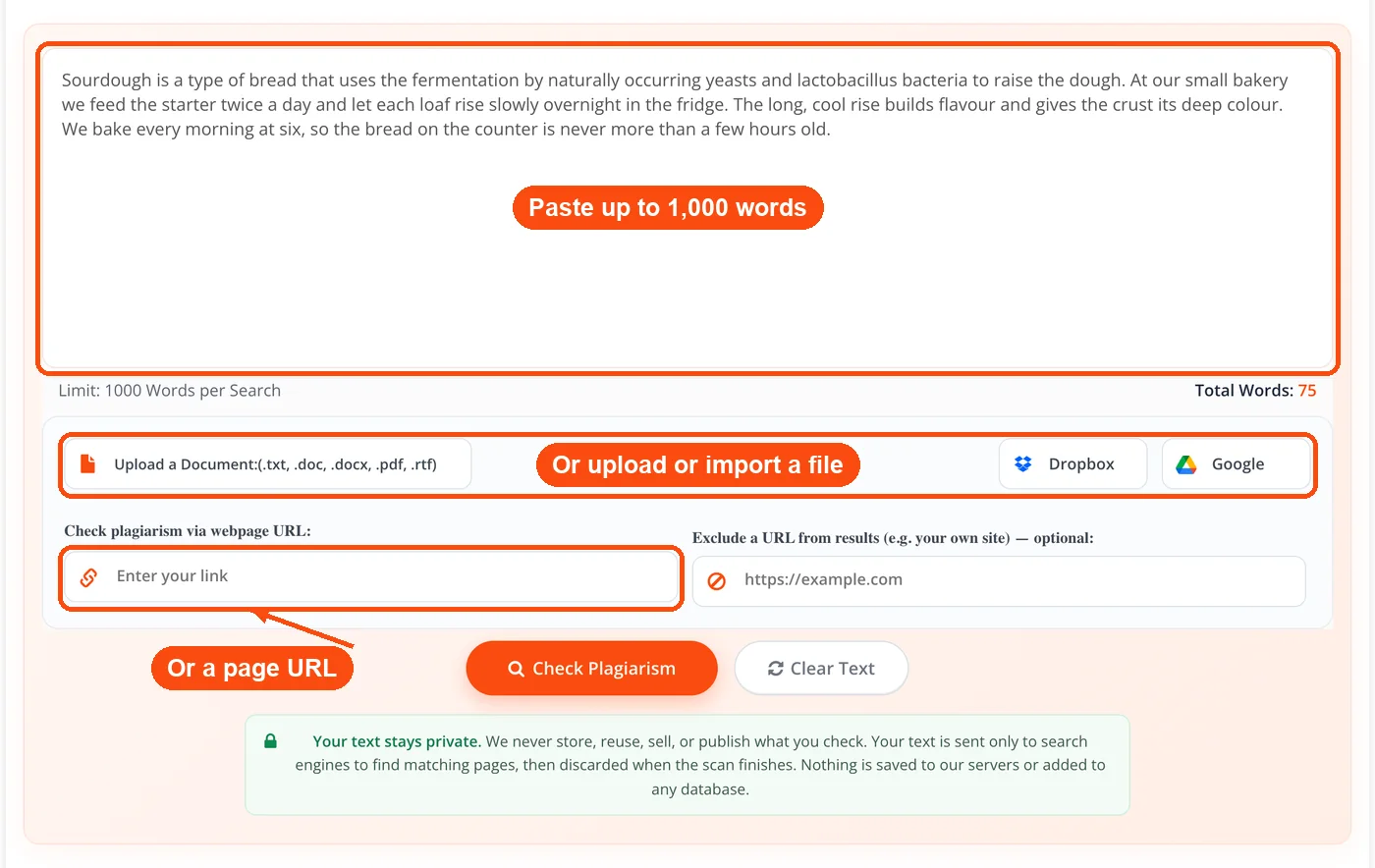
- Add your content. Paste text straight into the box (up to about 1,000 words per scan), upload a file in DOC, DOCX, RTF, TXT, or PDF format, or pull a document in from Dropbox or Google Drive. You can also drop in a web page URL and let the tool fetch the page text for you.
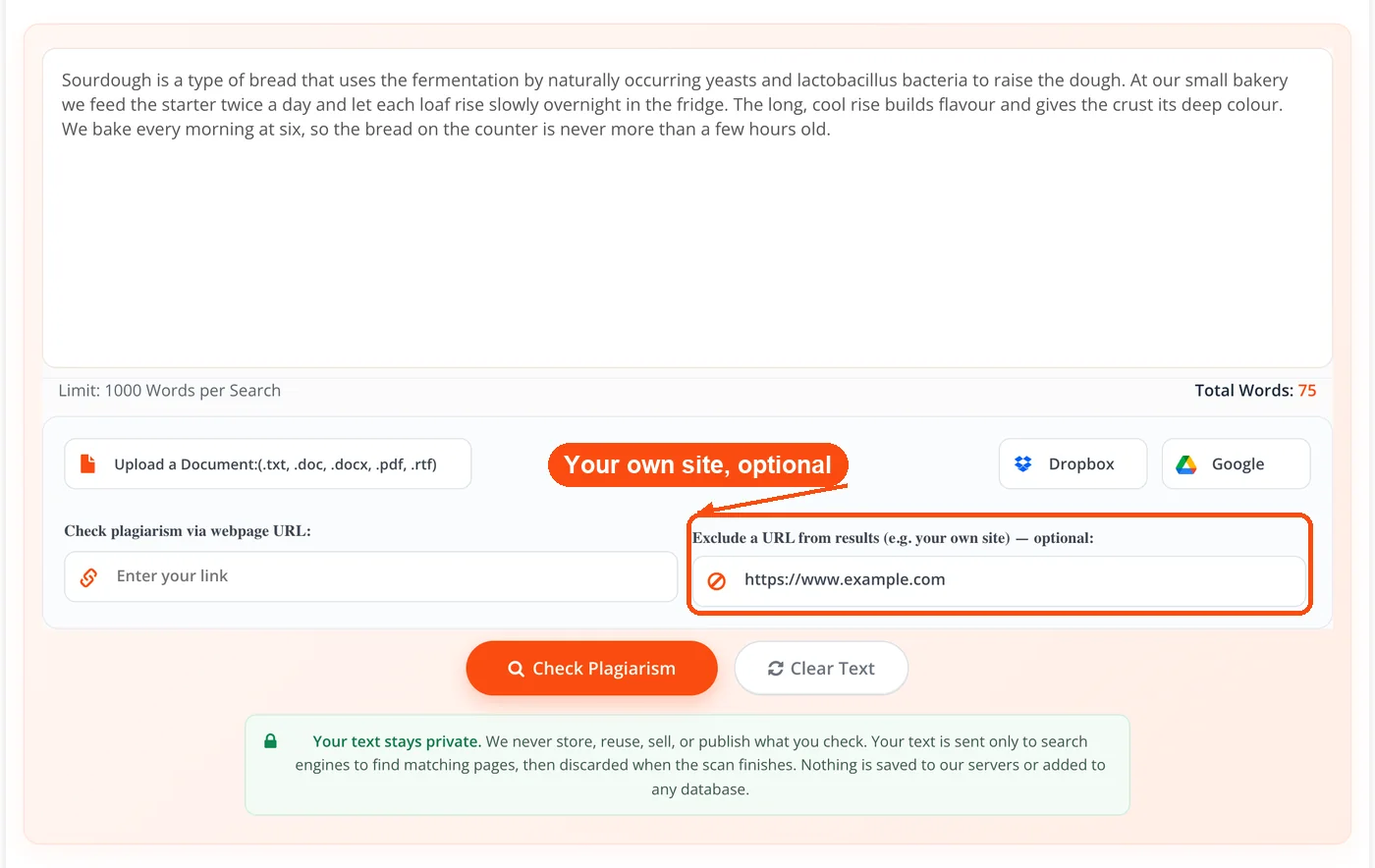
- Exclude your own site (optional). If you're checking a page you published, add that URL to the exclude field so your own copy doesn't count against you as a match.
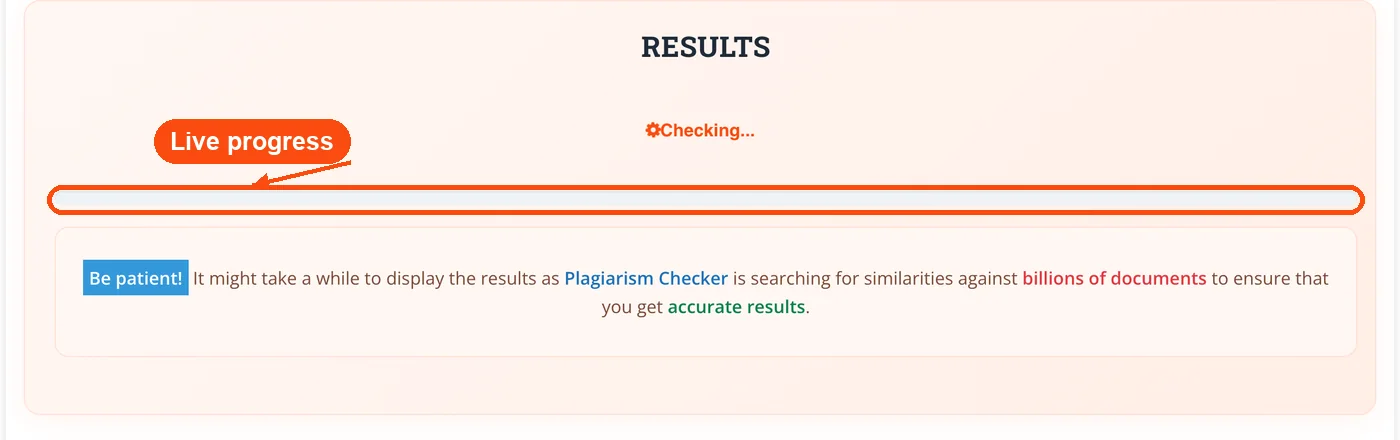
- Click "Check Plagiarism." The tool searches each sentence against the indexed web and tracks progress in real time. Most scans finish in 10 to 45 seconds depending on length.
- Read the report. You'll get a SIMILAR and an ORIGINAL percentage beside the results, plus two views to dig into. The Sentence Wise view tags each sentence as plagiarized or unique. The Document View shows your full text with copied passages highlighted in place.
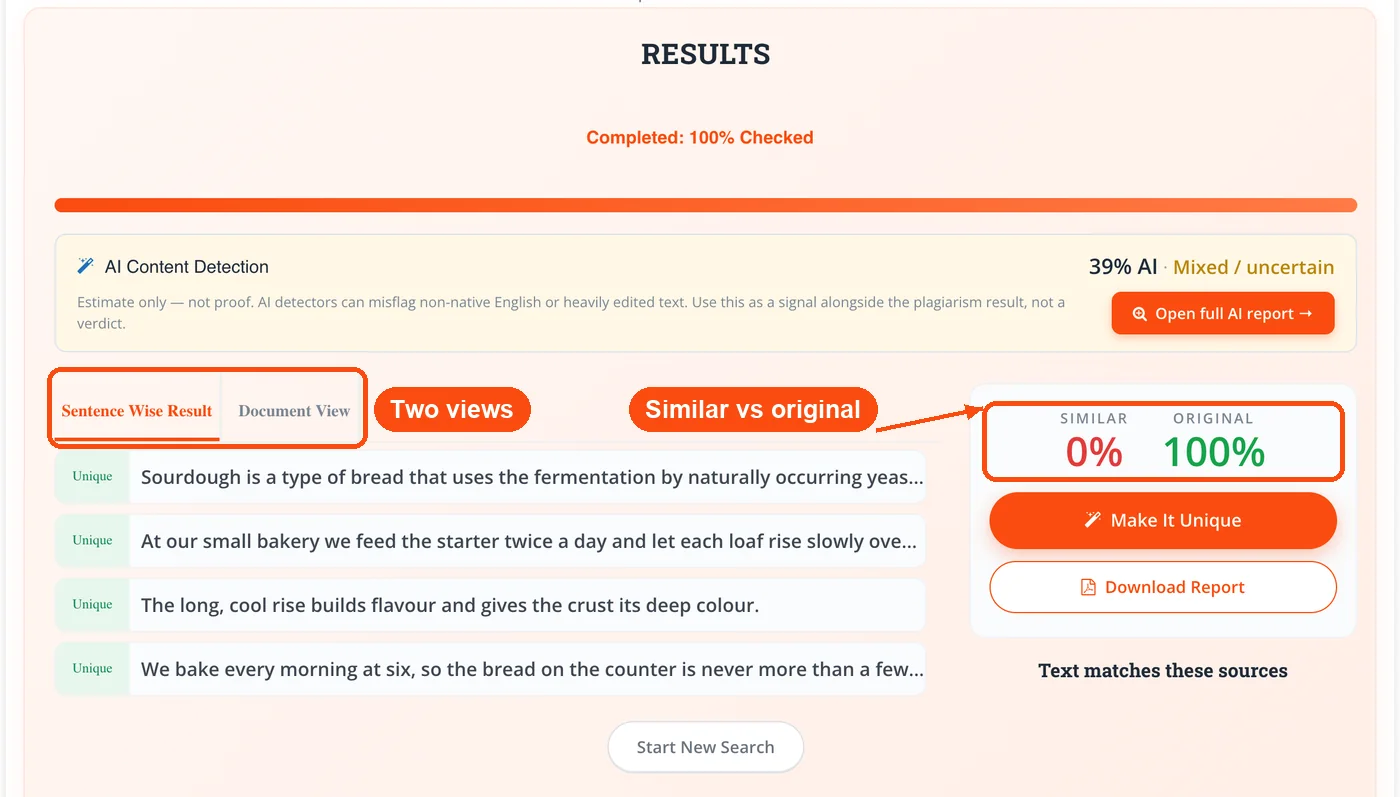
From there you can exclude individual sources you don't care about, hit "Make It Unique" to rewrite flagged lines in the paraphrasing tool, or download the full report as a PDF.
Features of the Plagiarism Checker
The tool does more than spit out a single percentage. Here's what you actually get.
- Sentence-level report: Your text is broken into individual sentences and checked one at a time, so you see exactly which lines overlap with existing content instead of a vague bulk score.
- Matched source links: Every flagged sentence comes with the source it matched, shown with a similarity percentage and a link you can click to compare side by side.
- Two result views: Sentence Wise isolates each flagged line. Document View highlights matched passages inside your full text so you can spot patterns at a glance.
- Paraphrase detection: Beyond exact matches, an optional semantic pass flags reworded copying that simple phrase matching misses. It's tuned conservatively to avoid false alarms, so treat it as a strong hint rather than a verdict.
- AI-writing estimate: The tool gives a rough signal of how likely your text reads as AI-generated. That makes it a basic AI plagiarism checker too, but treat it as an estimate, not proof, and note that it leans toward English text. For a closer look, the dedicated AI content detector breaks the signal down further.
- Multiple input methods: Paste, file upload, Dropbox, Google Drive, or URL. Enter a page address and it works as a plagiarism checker for websites, fetching the page text for you. No copy-paste gymnastics from a PDF.
- Multilingual support: The scanner segments text in scripts that don't use spaces, like Chinese, Japanese, and Thai, so non-English content gets counted correctly.
- Downloadable report: Save a branded PDF with the summary, sentence breakdown, matched sources, and highlighted document. Handy for attaching to client deliverables or editorial files.
- Privacy by default: Your text is deleted after the scan. It isn't stored in a database, indexed, or reused for future comparisons, which matters when you're working with drafts that aren't public yet.
How Does a Plagiarism Checker Work?
ToolsPivot's plagiarism checker works by searching the web, not by querying a private academic database. Knowing the mechanics helps you read the results correctly.
First, your text is split into sentences. The segmentation handles scripts without spaces, so a paragraph of Chinese or Thai is broken up just as cleanly as English.
Each sentence is then searched as an exact phrase against the publicly indexed web. Sentences that turn up on existing pages get flagged, and those pages become your matched sources. To keep scans fast, results are cached and many sentences are searched at the same time rather than one after another.
Next comes the paraphrase pass. Sentences that survive the exact-match search can be checked for meaning similarity using text embeddings, which compare how close two passages are in intent rather than wording. This catches reworded copying that phrase search alone would miss. The threshold is deliberately cautious to keep false positives down.
Finally, a separate heuristic estimates how AI-generated the text reads and produces the branded PDF report. The honest summary: this is web-search matching plus a semantic signal, not a proprietary journal archive. That makes it excellent for web, blog, and SEO originality checks, and it's the reason it can't replace an institutional tool for graded academic submissions.
Honest Limits Worth Knowing
A good originality check is only useful if you understand what it can and can't see. Here are the real boundaries.
- About 1,000 words per scan. For a 2,000-word article, split it into sections and run each separately. Confirm your section sizes with the word counter tool before you paste.
- Roughly 25 checks per day per user. That covers normal writing and editing work without a subscription, but it isn't built for bulk-scanning hundreds of pages at once.
- Public web only. The tool compares your text against publicly indexed pages, not against paywalled journals, private academic databases, or student-paper archives. It's a content and SEO originality tool, not a Turnitin replacement.
- Signals, not certainties. The paraphrase and AI-writing results are estimates. Use them to guide a closer human read, not as final proof of anything.
We'd rather tell you this up front than let a clean report give you false confidence on an academic submission it was never designed to grade.
Reading Your Plagiarism Percentage and Report
This is a plagiarism checker with percentage results at two levels: a SIMILAR and ORIGINAL split for the whole text, and a match percentage beside each source it found. A plagiarism percentage on its own doesn't tell the whole story. A 15% match might be three properly cited quotes, or it might be a lifted paragraph. The detail lives in the views.
Start with the Sentence Wise tab to see each flagged sentence next to its match. If a flagged line is a quote you've already cited, that's fine. The tool catches overlap, it doesn't judge whether your citation is correct, so that judgment stays with you.
Then check the matched sources. If several sentences all point to one URL, you may be leaning too hard on a single source. For web and SEO content, the Document View is usually the most useful, since it shows matched sections in context and helps you spot when, say, your product copy echoes a competitor's page. Rework those lines with the article rewriter or the paraphrasing tool, then rescan to confirm the fix.
| Uniqueness Score |
What It Means |
What To Do |
| 90 to 100% |
Highly original |
Good to publish or submit |
| 75 to 89% |
Some overlap |
Review flagged lines, cite or paraphrase |
| 50 to 74% |
Significant duplication |
Rewrite matched sections first |
| Below 50% |
Mostly matches existing sources |
Major rewrite needed |
Who This Free Plagiarism Checker Is For
This free plagiarism checker, no sign-up needed, is built for people who write and publish on the web, not for institutional grading. A few groups get the most out of it.
Bloggers and content writers scan drafts before they go live to make sure nothing accidentally mirrors a source they researched. A quick pass before publishing protects both rankings and reputation.
SEO professionals and site owners use it to catch duplicate content that can drag pages down in search. Checking pages by URL during a content audit surfaces overlap you didn't know existed. Cross-reference the results with the keyword density checker so rewritten copy still targets the right terms, and run your meta tags through an analysis while you're at it.
Freelancers and agencies attach a downloadable report to client deliverables as proof of original work. When you're managing a roster of writers, a 60-second scan per article is cheap insurance.
Students doing self-checks use it as a plagiarism checker for essays, running drafts before submission to find unintentional matches and fix citations early. Just remember this checks the public web, so it complements your school's official tool rather than replacing it.
Editors and publishers verify submitted manuscripts against the web before they commit to publishing, using the matched source links to cross-check anything that looks borrowed.
Frequently Asked Questions
Yes, this one. It's an online plagiarism checker free for anyone to use, with no signup: you don't need an email address, a login, or a credit card. Each scan covers up to about 1,000 words, within a fair-use limit of roughly 25 scans per day.
It's reliable for web-published content because it matches your text against the publicly indexed web and adds a paraphrase signal on top. No tool catches everything, though, since paywalled databases and private archives aren't indexed, so treat a clean result as strong evidence rather than absolute proof.
Each scan handles up to about 1,000 words. For longer pieces, break the text into sections and run them separately, and use the readability checker to review each section while you're there.
It helps catch paraphrased text using a semantic pass that compares meaning, not just exact wording. It's tuned conservatively to avoid false positives, so it flags likely reworded copying rather than guaranteeing it finds every instance.
It gives an estimate of how AI-generated the text reads, shown as a signal rather than a verdict. The estimate leans toward English writing, so use it alongside a dedicated AI detector for a closer look, and rework any flagged passages with the AI humanizer.
The tool accepts DOC, DOCX, RTF, TXT, and PDF files. You can also import from Dropbox or Google Drive, paste text directly, or check a live web page by URL.
No, it checks the public web rather than private academic or journal databases. That makes it a solid fit for blogs, SEO, and content originality, but for graded academic submissions you should still use your institution's official tool.
No. Your text is deleted once the scan completes and is never saved to a database, indexed, or reused for future comparisons, which keeps unpublished drafts and confidential material private.
The scanner works across many languages and correctly segments scripts that don't use spaces, such as Chinese, Japanese, and Thai. Detection is most accurate for English simply because the indexed web is mostly English-language content.
Yes. After any scan you can save a branded PDF that includes the summary, the sentence-by-sentence breakdown, the matched sources, and your highlighted document, which is useful for client files and editorial review.
ToolsPivot gives you the full plagiarism report, including matched sources and sentence-level results, for free with no signup, while Grammarly and QuillBot put plagiarism detection behind a paid plan. Premium tools do add things like academic databases, so they're worth it for institutional work, but for web and content checks a free tool covers the job. Once you've cleaned up flagged lines, a quick pass through the grammar checker gets the draft ready to publish, and the questions explorer tool can help you build out original sections that won't overlap with anyone else.
A plagiarism checker is a tool that compares your text with content that already exists and flags the passages that match. This one searches the public web sentence by sentence, then shows a plagiarism percentage and a link to every source it found.
It depends on what your work will be checked against. For graded submissions, the best check is the one your school uses, often Turnitin, because it compares essays with student-paper archives that no free tool can see. For self-checks before you submit, this free tool works well: paste up to about 1,000 words per scan (split longer essays into parts), then fix any web matches or missing citations it finds.

