Reverse Image Search
Run a free reverse image search to find where a picture appears online, track down the original source, or check if a photo is real. Search Google Lens, Yandex, Bing and TinEye at once, from one upload.
Up to 15 MB · JPG, PNG, WebP, HEIC, GIF
About Reverse Image Search
Reverse image search is a free tool that finds where a picture appears online, traces it back to its original source, and helps you check whether a photo is real. Instead of typing words, you start with the image itself. ToolsPivot takes one upload and fans it out to Google Lens, Yandex, Bing, and TinEye at the same time, because each engine crawls different parts of the web and finds things the others miss. Drop a file, paste a link, or snap a photo, and you have your answer in seconds.
What This Tool Does
The reverse image search tool takes a single image and searches four engines at once to find matches, sources, and lookalikes across the public web. You give it a picture, it prepares that picture in your browser, then hands you one button per engine so you can open Google Lens, Yandex, Bing, and TinEye results in separate tabs. The heavy lifting stays local: the image is resized and cropped right in the browser before anything leaves your device.
Photographers, journalists, online daters, e-commerce sellers, and researchers use it most. A photographer hunts for stolen work, a reporter verifies a viral photo before publishing, and someone on a dating app checks whether a profile picture belongs to a real person or a scammer.
The old way meant running the same picture through three or four sites by hand, one browser tab at a time. This tool collapses that into a single upload. What used to take ten minutes of copying, pasting, and reformatting now takes about ten seconds.
Key Benefits
- Four engines from one upload: You search Google Lens, Yandex, Bing, and TinEye together instead of visiting each site separately, so nothing slips through the gaps between indexes.
- Crop before you search: Isolate a single face, logo, or product and search just that part, which almost always beats searching the whole busy frame.
- Five ways to add an image: Drag and drop, pick a file, paste from your clipboard, paste a URL, or shoot a photo with your phone camera.
- No silent failures: Oversized and iPhone HEIC files that break other tools are auto-converted and auto-resized so your search actually runs.
- Honest privacy you can verify: File uploads sit at a temporary link only long enough for the engines to read them, then delete automatically. Paste a URL and nothing uploads at all.
- Free with no account: No signup, no email, no daily search cap, and the full interface works in 18 languages.
- The right engine for the job: Each engine carries a plain "best for" hint, so you know to check Yandex for a face and Bing for a product.
Core Features
- Multi-engine fan-out: One prepared image builds a correct deep link for Google Lens, Yandex, Bing, and TinEye, each opening in its own tab with a single click.
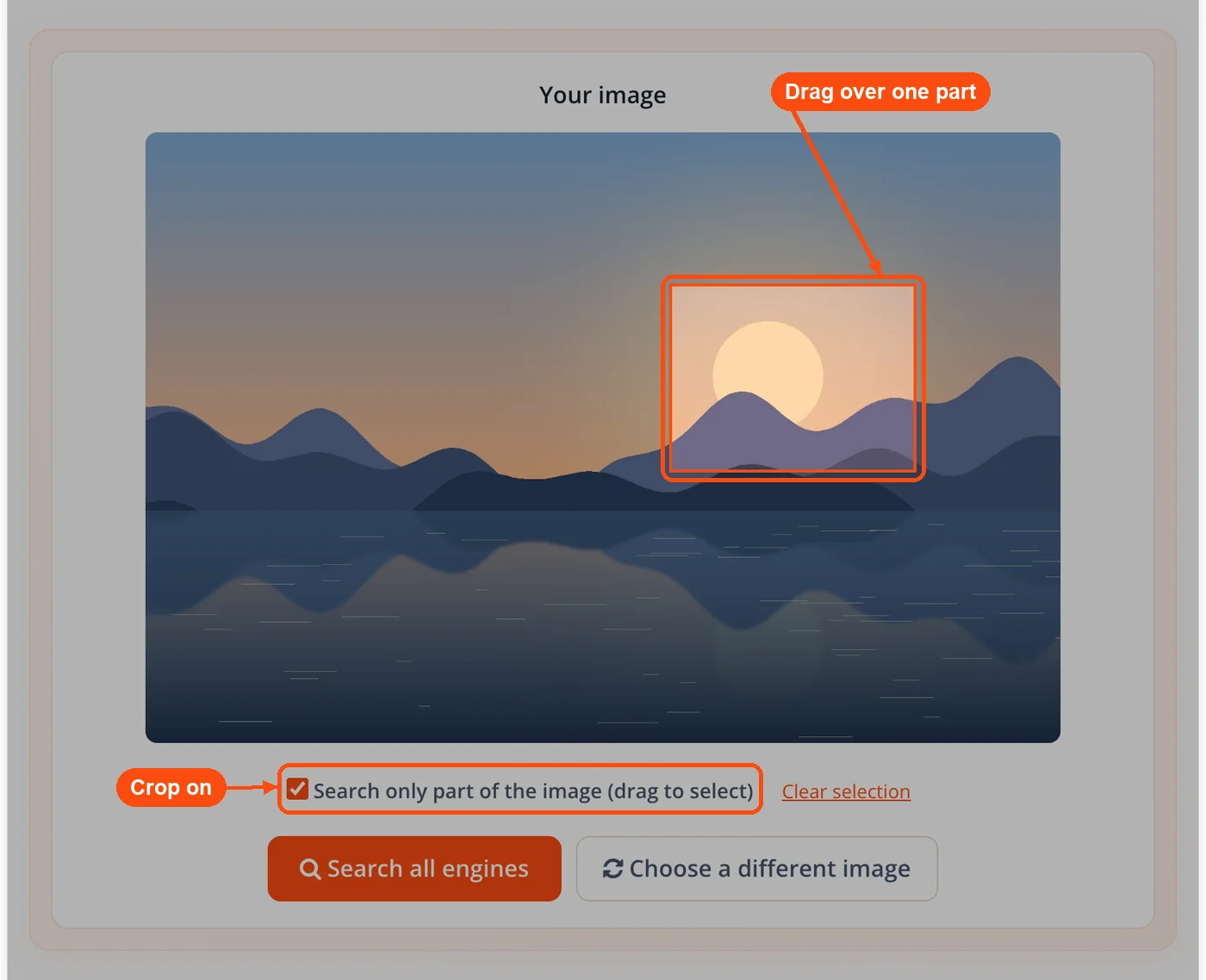
- Drag-to-select cropping: Toggle "search only part of the image" and drag a box over the preview to cut out the exact element you care about.
- Clipboard paste: Copy an image anywhere and press Ctrl or Cmd plus V to drop it straight into the search, skipping the save step entirely.
- Camera capture: On a phone, take a photo and search it on the spot, useful for products in a store or a printed picture on a page. It is a reverse image search iPhone and Android users can run straight from the browser, with no app to install.
- HEIC and HEIF conversion: iPhone photos are converted to JPEG in the browser so they work with engines that reject Apple's format.
- Automatic resizing: The longest side is capped at 2048 pixels, which keeps files small and stops the uploads that quietly fail on other tools.
- Reverse image search by URL: Paste a direct image link into the reverse image search URL box and the tool skips its server completely, sending nothing from your device.
- Format flexibility: Accepts JPG, PNG, WebP, HEIC, and GIF up to 15 MB, a wider range than the JPG-only tools it replaces.
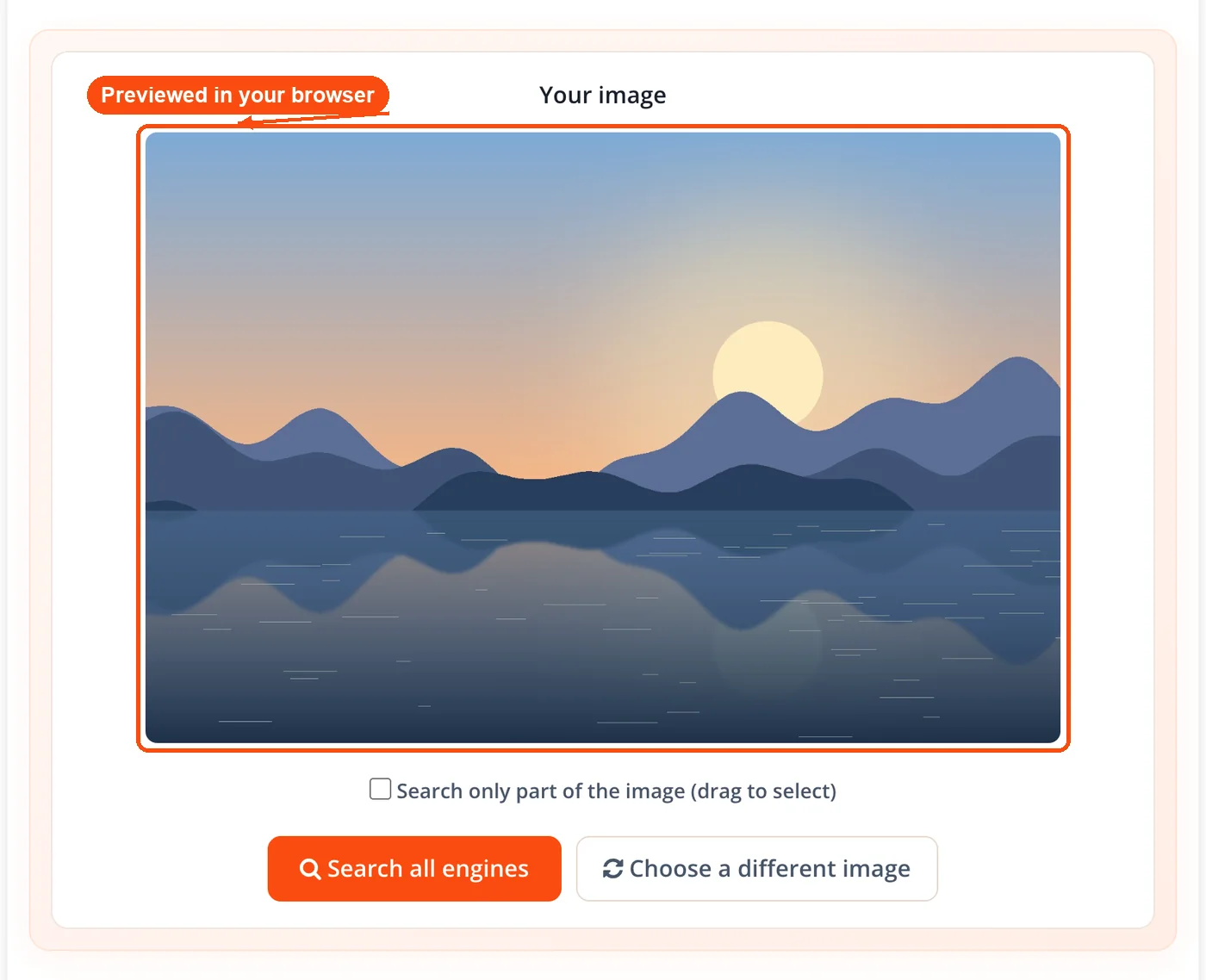
- Image preview: See a thumbnail of exactly what you're about to search before you commit, so you never search the wrong frame.
- Empty-result guidance: When an engine returns nothing, a tip reminds you that "not found" is not "not out there," and points you to another engine or a tighter crop.
How to Do a Reverse Image Search
Add your image. Drag a file in, click to browse, paste from your clipboard, paste an image URL, or open your camera on mobile.
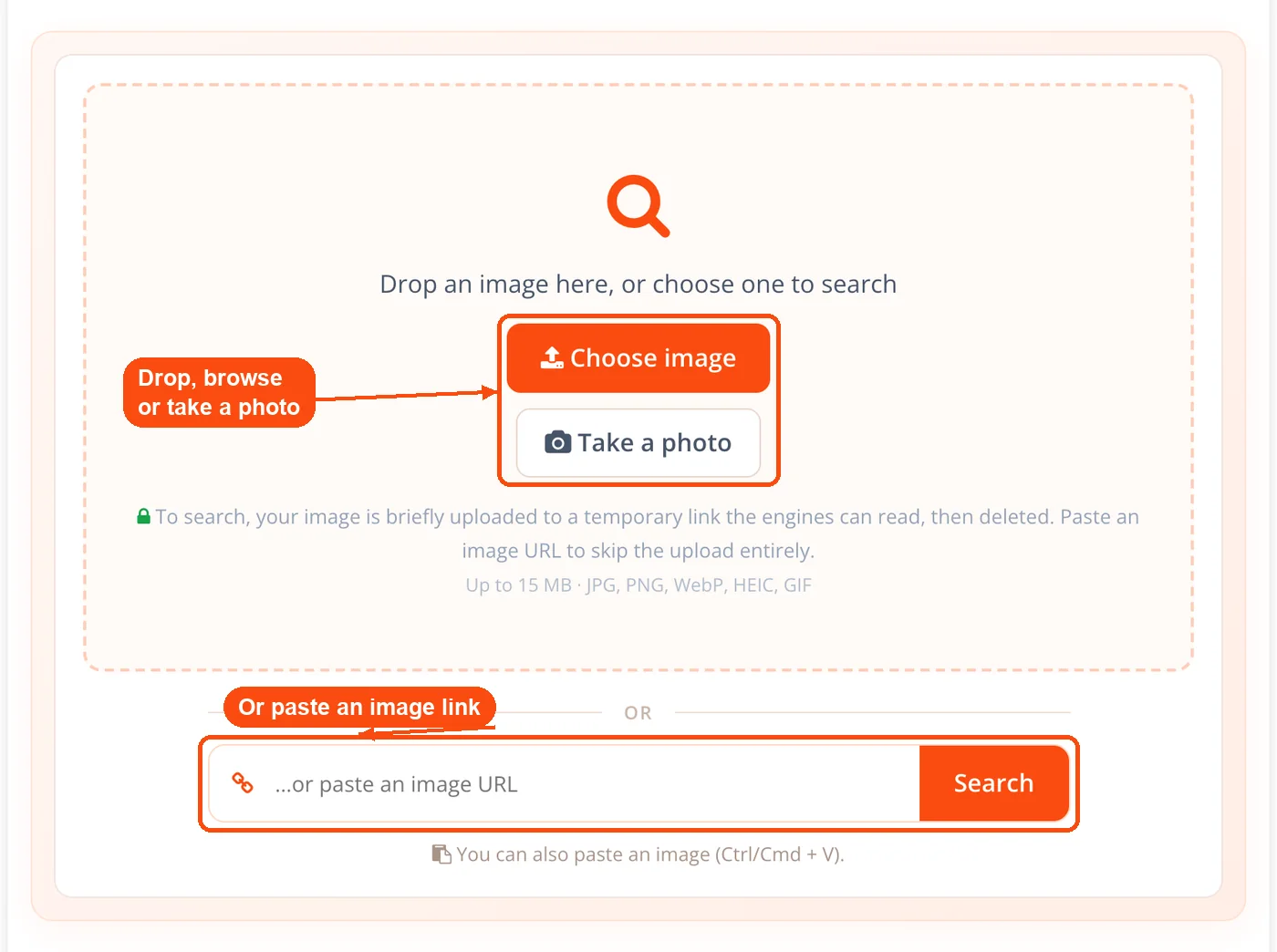
Let it prepare the file. A HEIC photo converts to JPEG in your browser, and you see a preview of the image. When you search, it is scaled down to fit (2,048 px at most), also in your browser.
Crop if you want to. Turn on the crop box and drag over the preview to search a single face, logo, or product instead of the whole scene.
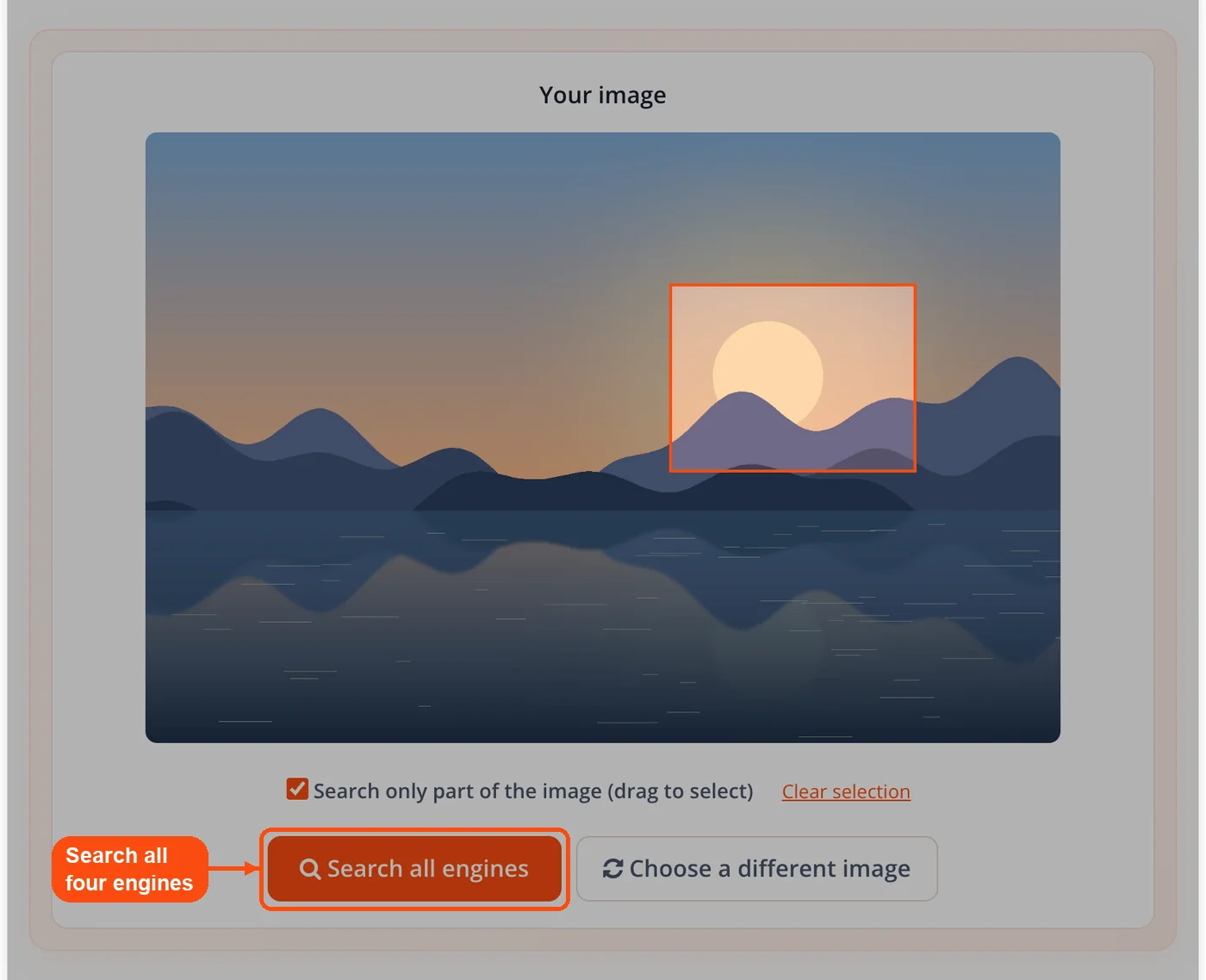
Search all engines. Click search, and ToolsPivot builds a proper link for Google Lens, Yandex, Bing, and TinEye, showing one open button per engine.
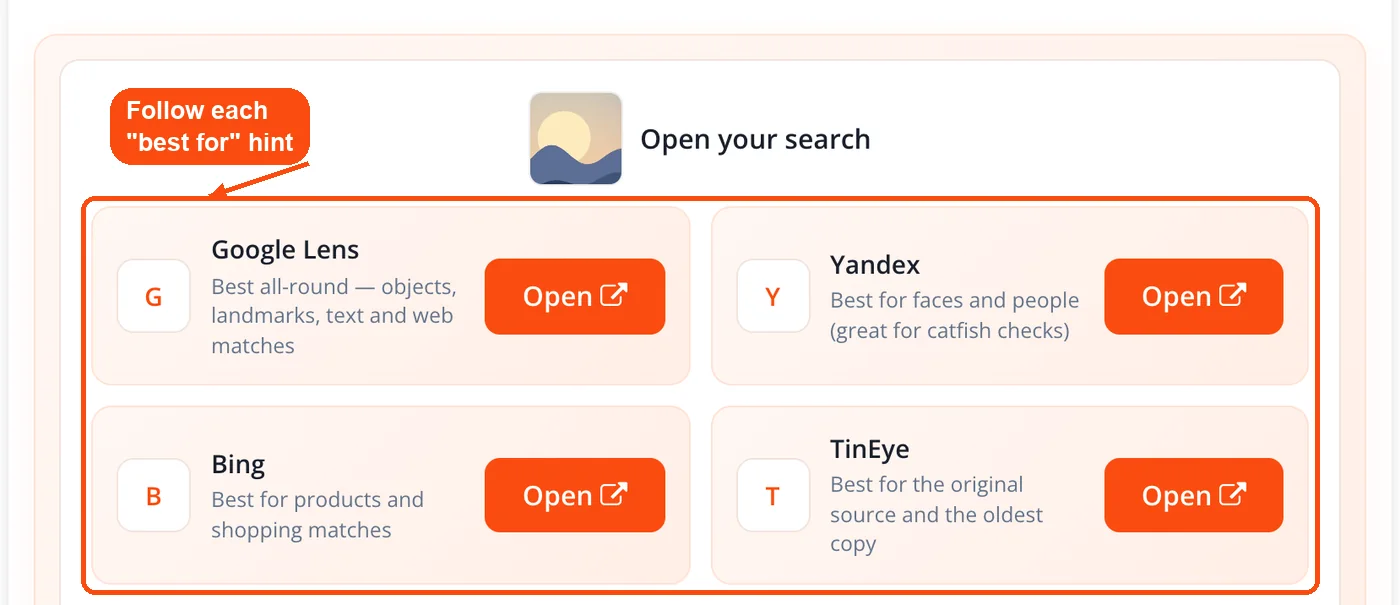
Pick the engine that fits. Follow the "best for" hint on each card, then review exact matches, similar photos, and the source pages behind them.
When to Use It
Reach for reverse image search whenever you have a picture and need to know where it came from, where else it lives, or whether it can be trusted. It answers questions that a normal text search cannot, because you often have no words to describe what you're looking at.
- Checking a dating profile: Confirm a match's photos aren't lifted from a stranger's social account or a stock library before you meet.
- Tracing stolen artwork: Find every site republishing your photo or design without a credit or a license.
- Verifying breaking news: Confirm a viral photo is real and recent, not an old picture recycled from a different event.
- Identifying a product: Snap a photo of an item and find where to buy it or what it's called.
- Finding a bigger version: Turn a blurry thumbnail into the full-resolution original from its source page.
- Citing a research image: Trace a historical photograph to its archive for a proper reference.
The one place it falls short is anything not published on the open web. Private accounts, printed pages, and offline records stay invisible to every engine.
Use Cases
Photographer Tracking Stolen Work
Context: A wedding photographer suspects studios are reusing her portfolio shots without credit. Process:
- She crops each image to the most distinctive element before searching.
- She runs all four engines and notes every unauthorized site.
- She captures each offending page with the website screenshot generator. Result: A 30-minute audit surfaces dozens of infringing sites, each documented for a DMCA notice.
Reporter Verifying a Viral Photo
Context: A dramatic disaster image is spreading with a claim it was shot yesterday. Process:
- The reporter pastes the image URL, uploading nothing from the newsroom.
- TinEye sorts matches by date to surface the oldest copy.
- The earliest result predates the claimed event by two years. Result: The photo is flagged as recycled and the false story gets stopped before publication.
Seller Hunting Counterfeit Listings
Context: An electronics brand keeps seeing its product photos on knock-off listings. Process:
- The team runs a Bing reverse image search on official product shots to find shopping matches.
- Suspicious marketplace domains get a website safety check.
- Confirmed counterfeits are collected for the legal team. Result: Nineteen unauthorized listings are documented across three marketplaces in an afternoon.
Dater Spotting a Catfish
Context: A too-good-to-be-true profile photo raises suspicion before a first date. Process:
- The user crops tightly to the face and runs Yandex first.
- The same photo turns up on an unrelated influencer's account.
- A quick pass through the social stats checker confirms the profile is fake. Result: A scam is caught before any money or time is lost.
Reverse Image Search Engines Compared
No single engine wins every search, which is exactly why this tool runs four at once. Each one crawls a different slice of the web and specializes in a different kind of match. Sending your image to all four is the difference between five results and fifty.
| Engine | Best For | Why It Wins Here |
|---|---|---|
| Google Lens | All-round: objects, landmarks, text, broad web matches | The widest general index and strong object and scene recognition |
| Yandex | Faces and people, including catfish and scam checks | The strongest face matching, especially for everyday non-celebrity photos |
| Bing | Products and shopping | Good at matching retail photos and surfacing purchase links |
| TinEye | The original source and the oldest copy | A dedicated index of more than 77 billion images, sortable by date |
A photographer might find fifteen matches on Google, eight different ones on Bing, and five more on Yandex that neither of the others caught. The overlap between engines is smaller than most people expect. For a real person's face, Yandex reverse image search usually beats Google. For a product or landmark, start with Google Lens. TinEye is the one to open when you need the earliest appearance of an image, since it sorts by date and is built to track exact and lightly edited copies over time.
Getting Sharper Results
Start with the highest-quality version you have. Compressed thumbnails and screenshots give the engines less to work with, so exact matches drop off. If your only copy is tiny, scale it up first with the image resizer before you search.
Crop tight. A face in a crowd or a logo in the corner searches far better on its own than buried in a busy photo. The built-in crop box handles this, and the online image cropper gives you finer control for tricky edits. If a photo is sideways, fix it with the rotate image tool first, since orientation throws off matching.
Watch your file size and privacy. Anything over 15 MB should go through the image compressor first. If a photo carries GPS coordinates or a camera serial you'd rather not expose, strip them with the EXIF data remover before uploading. The search still works fine, since it reads pixels, not file properties. To confirm ownership on your own originals instead, the EXIF data viewer shows the metadata baked into the file.
How Does Reverse Image Search Work?
Reverse image search runs on content-based image retrieval, which reads the actual pixels in a photo rather than its filename or alt text. The engine extracts features like color distribution, edges, and texture, then compresses them into a compact numerical fingerprint. That fingerprint gets compared against billions of others already stored in each engine's index.
Google Lens layers neural networks on top, trained to recognize specific objects, landmarks, and text inside the frame. That's why a photo of the Eiffel Tower returns results about Paris even when the file is named "IMG_4392.jpg" with no metadata at all. If your goal is pulling exact colors out of an image rather than finding its source, the color picker does that job instead.
Because the engines fetch your image from a web address, a file has to reach a public link before it can be searched. That's the honest architecture behind every free multi-engine tool, and it's why pasting a URL, which skips the upload entirely, is the most private route when you already have a link.
Honest Limitations
This tool has real boundaries, and naming them matters more than pretending they don't exist.
It only searches the open, indexed web. Private social accounts, messaging apps, printed materials, and offline records are invisible to every engine, so a photo that only ever lived in a locked profile may return nothing.
A file upload is not fully private. To let the engines read your image, an uploaded file is briefly placed at a temporary public link and then deleted automatically after 30 minutes. That's genuinely temporary, but it isn't the same as "never uploaded." When privacy is critical and you already have a link, paste the URL instead, because that path sends nothing from your device. This is why ToolsPivot states the model plainly rather than claiming images are never stored.
It can't reliably flag AI-generated images. Reverse search finds where a picture has appeared, not whether software made it. A synthetic image that was never published simply returns no results, which is a hint, not proof.
"No results" is not a verdict. TinEye skips most social platforms, and no index covers the entire web, so an empty page means "not found here," not "does not exist." Switch engines, crop tighter, or try a higher-resolution copy before you conclude anything.
Frequently Asked Questions
Reverse image search is a way to search the web with a picture instead of words. The engine reads the image's pixels, turns them into a compact fingerprint, and returns pages that show the same or similar images. ToolsPivot sends one picture to Google Lens, Yandex, Bing, and TinEye at once, so you can compare what each engine finds.
Yes, it's completely free with no signup, no email, and no daily search limit. The full interface is available in 18 languages, and every feature works the moment the page loads.
The tool searches Google Lens, Yandex, Bing, and TinEye from a single upload. Each opens in its own tab, and each carries a hint about what it finds best.
You can upload JPG, PNG, WebP, HEIC, and GIF files up to 15 MB. iPhone HEIC photos are converted automatically, and the longest side is resized to 2048 pixels so uploads stay small.
An uploaded file is placed at a temporary public link so the search engines can read it, then deleted automatically after 30 minutes. If you paste an image URL instead of uploading, nothing leaves your device at all.
Yes, you can crop before searching. Toggle the crop box, drag over the preview to isolate a face, logo, or product, and the tool searches just that region for sharper matches.
Yes, on iPhone or Android you can capture a photo and search it immediately. That makes it easy to identify a product in a store or check a printed picture on the spot.
Google Lens searches only Google's index, while this tool runs Google Lens, Yandex, Bing, and TinEye together. Since each engine crawls different sites, four searches from one upload usually surface far more total results.
TinEye is a single engine with its own index of more than 77 billion images, and it's best for finding exact copies and the oldest version of a photo. This tool runs TinEye alongside Google Lens, Yandex, and Bing, so you get its precision plus the reach of three other indexes.
Yandex tends to perform best for real people's faces, which makes it the first stop when you run a reverse image search for catfish and scam checks. Crop tightly to the face before searching for the strongest match.
Not directly, because reverse search finds where an image has appeared, not how it was made. An AI image that was never published returns no matches, which can hint at a synthetic origin without proving it.
An empty result usually means the image isn't indexed, not that it doesn't exist anywhere. Try a different engine, crop tighter, or search a higher-resolution copy before drawing conclusions.
Yes. Grab a thumbnail with the YouTube thumbnail downloader or turn code into a file with Base64 to image, then upload the result here to trace where it appears.
You can search a photo of someone to see where that same picture, or close copies of it, appears on the public web. Crop tightly to the face and start with Yandex, which is strongest on faces. The tool does not tell you who a person is and cannot see private accounts; it only shows public pages where the image has been published.


