Domain to IP Lookup
Use this domain to IP address lookup to find every IP a domain points to, not just one. See all IPv4 and IPv6 addresses with their reverse DNS, location, and hosting company, and find out when a site sits behind a CDN like Cloudflare. Paste one domain, or several.
About Domain to IP Lookup
This domain to IP address lookup is a free way to resolve domain to IP: it finds every IP address a domain points to, then tells you who owns each address and roughly where it sits. Most free tools that convert domain to IP hand back a single IPv4 address and stop there. The ToolsPivot version returns the full A and AAAA record set, adds reverse DNS, hosting organisation, location and TTL to each address, and flags when a site is sitting behind a CDN. No account, no API key.
What the Domain to IP Lookup Shows You
The tool answers one question properly: where does this domain resolve, and who is on the other end. A domain rarely maps to a single machine. Large sites publish several A records for load balancing, add AAAA records for IPv6 clients, and route through a proxy network. A lookup reporting only the first address gives you a partial picture and no way to know it is partial.
Every resolved address arrives with six fields attached:
- IP and version: The A (IPv4) or AAAA (IPv6) address exactly as published in DNS.
- Reverse DNS (PTR): The hostname the address maps back to, which is often the clearest hint about who runs the server.
- Host and ASN: The organisation that owns the address block and its autonomous system number.
- Location: The approximate city and country of the datacenter holding that address.
- TTL: How long resolvers are told to cache the record before asking again.
- CDN: The content delivery network or cloud provider, when the address is recognised as an edge node.
Above the per-address table you also get the primary IP, the CNAME chain if the domain aliases to another hostname, and a banner when a CDN is detected. If you want the rest of the record types (MX, NS, TXT, SOA), the DNS lookup tool covers those separately.
Key Benefits
- Complete address list: You see every A and AAAA record, so a load-balanced or dual-stack site never looks like a single-server site.
- Ownership without a second tool: Reverse DNS, ASN and hosting organisation appear beside each address instead of requiring a separate IP lookup for each one.
- Honest CDN handling: When the addresses belong to Cloudflare, Akamai, Fastly or a major cloud, the page says so and states plainly that these are edge servers, not the origin.
- Cache troubleshooting built in: TTL values sit next to each record, which is what you actually need when a DNS change has not propagated yet.
- Alias visibility: The CNAME chain shows when a domain is pointing at a platform hostname rather than at an address directly.
- Batch work supported: Bulk input lets you find domain to IP mappings for a whole list at once, in one compact table, with copy, CSV and JSON export.
- No barrier to entry: No sign-up, no API key, and the interface is available in 18 languages.
Core Features
- Full A and AAAA resolution: Both IPv4 and IPv6 records are queried and returned together, not as two separate lookups.
- DNS-over-HTTPS resolution: Queries run over encrypted DoH against Cloudflare, with Google as a fallback resolver if the first request fails.
- Per-record TTL capture: Each record keeps the TTL value from the DNS answer rather than a generic estimate.
- CNAME chain reading: The alias path is pulled from the same answer, so you can see the hop from domain to platform hostname to address.
- Private address filtering: Loopback, RFC 1918 and link-local addresses are dropped, since a public domain has no business resolving to them.
- Batched enrichment: All resolved addresses go out in a single geolocation and ASN request rather than one call per address, which keeps large result sets fast.
- Fallback data source: If the primary enrichment provider does not answer, a secondary HTTPS provider fills the gap.
- PTR backfill: Any address missing reverse DNS from enrichment gets a direct PTR query over DoH.
- CDN signature matching: ASN, organisation name and reverse DNS are checked against known CDN and cloud patterns to label edge nodes.
- Plain-English explainers: Each field carries a short note explaining what it means and what it does not prove.
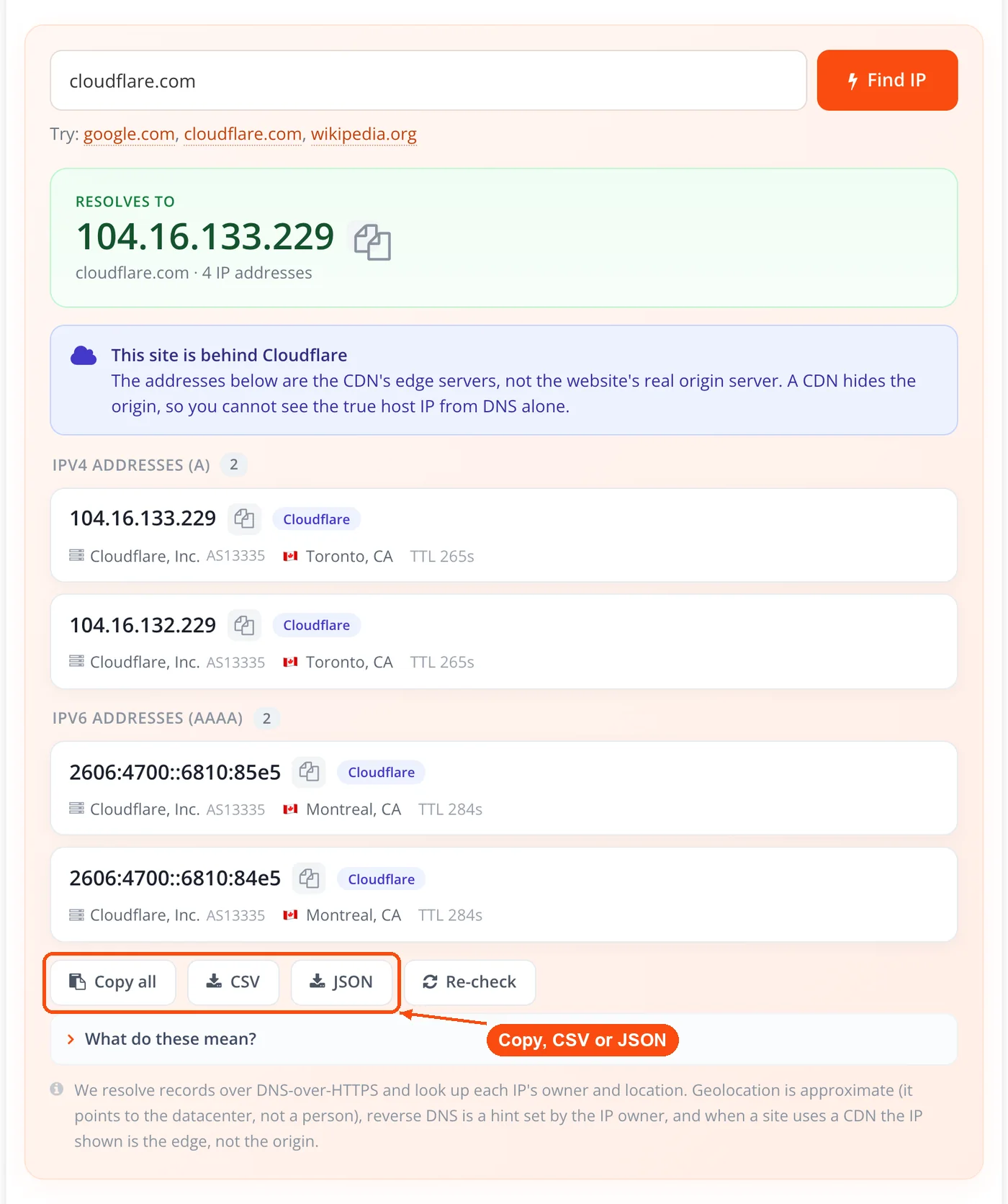
- Copy and export: Results can be copied as text or downloaded as CSV or JSON for spreadsheets and scripts.
- Bulk mode: Paste multiple domains and get a compact table covering all of them.
How ToolsPivot Domain to IP Lookup Works
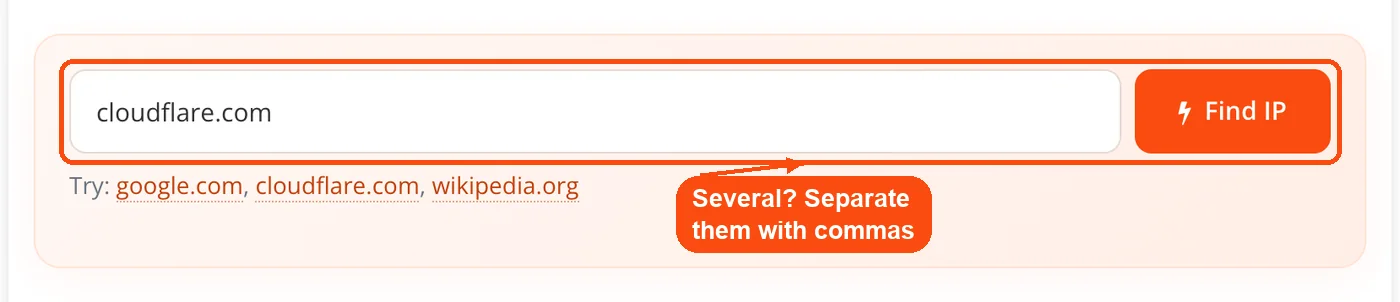
- Enter a domain and press Find IP. Type the bare domain, such as example.com, without a protocol prefix. Enter several domains separated by commas to run bulk mode instead.
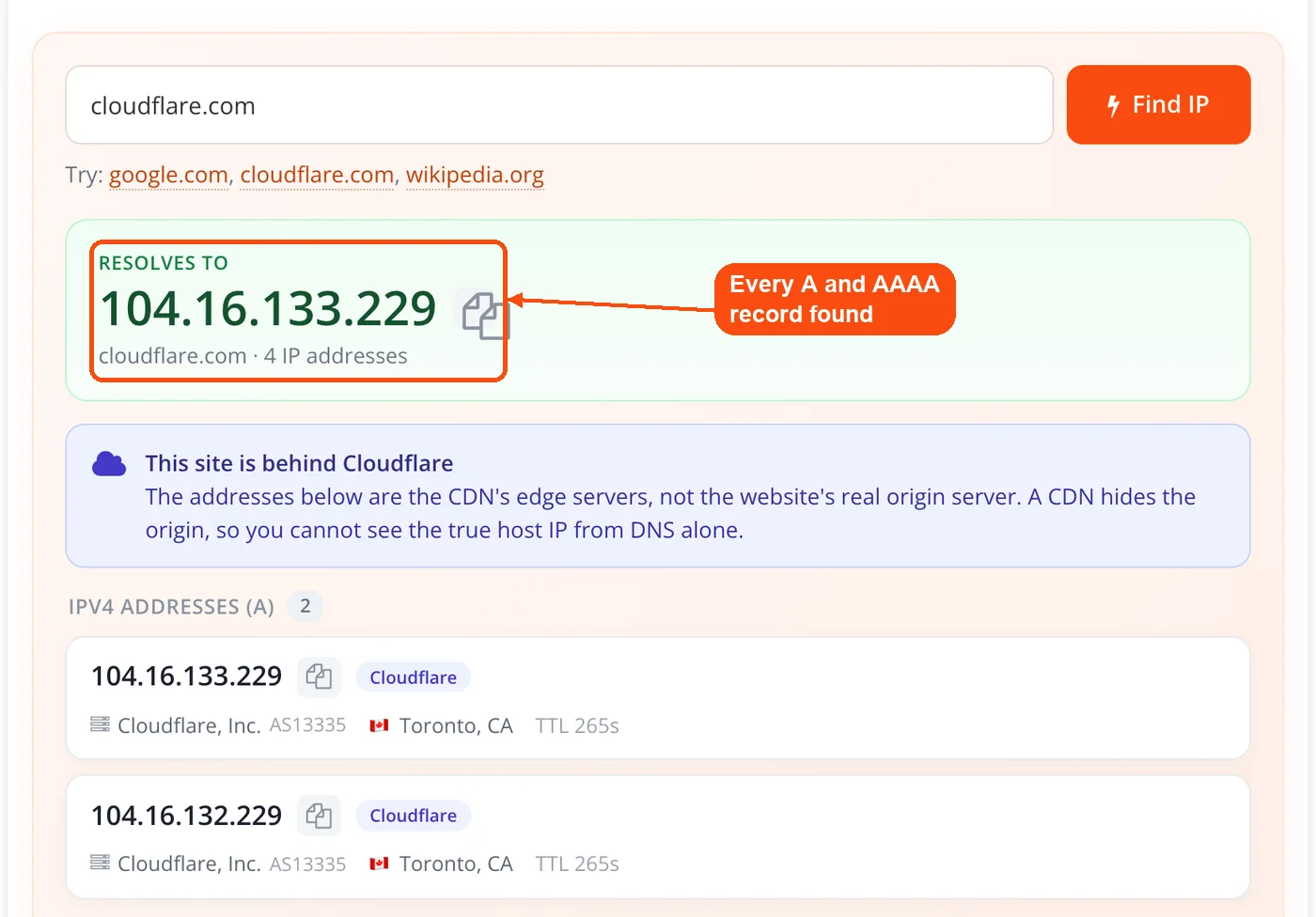
- Records are resolved over DoH. To resolve the domain to IP addresses, it is queried for all A and AAAA records over DNS-over-HTTPS, keeping each TTL and reading the CNAME chain from the answer.
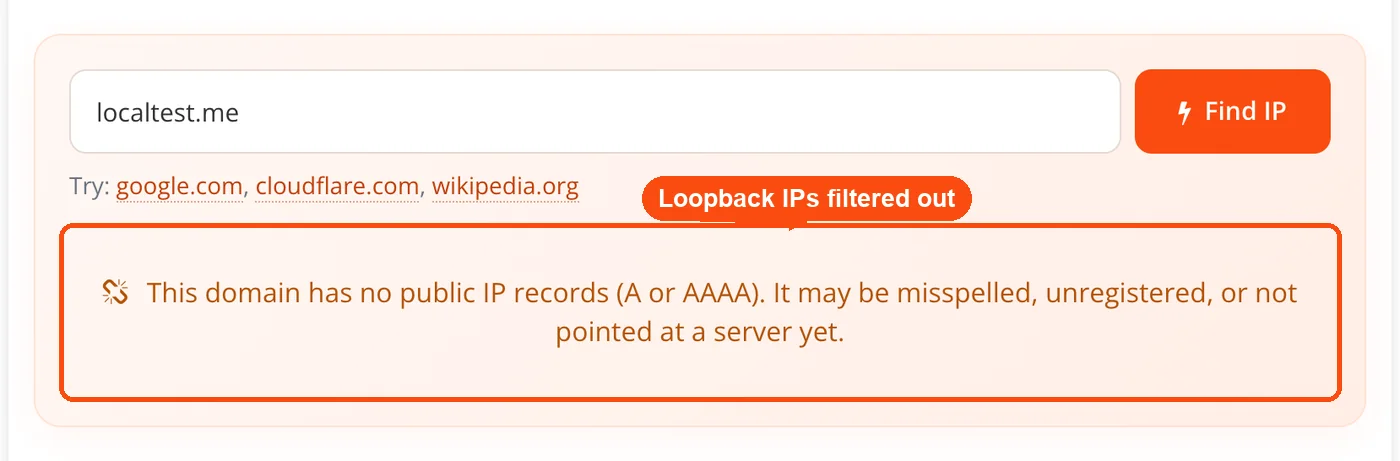
- Private and reserved addresses are filtered out. Anything in loopback, RFC 1918 or link-local space is removed before enrichment.
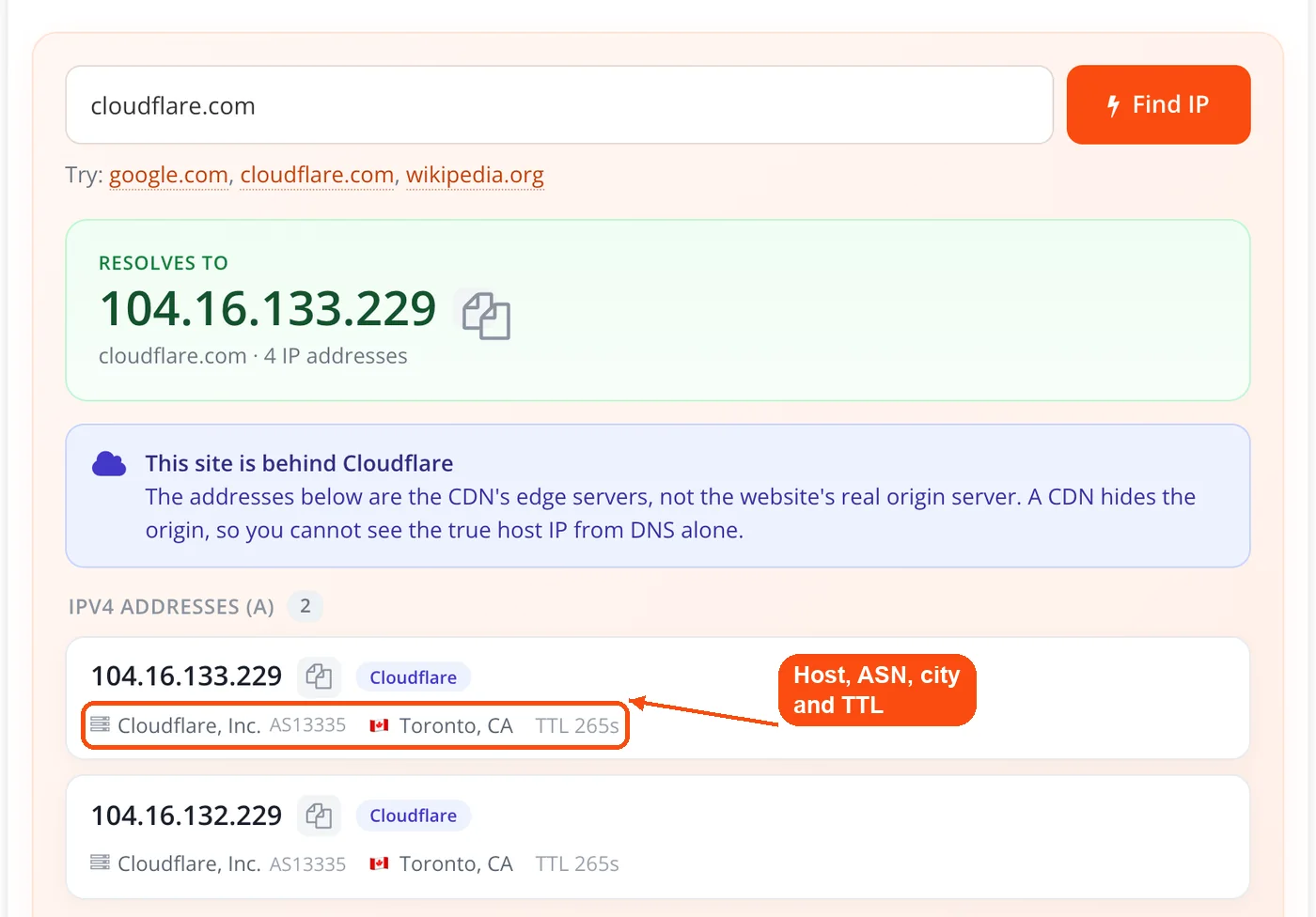
- Every address is enriched in one batch. The surviving addresses are sent together for geolocation, ASN, hosting organisation and reverse DNS, with a fallback provider and a direct PTR query for anything still missing.
- CDN edges are detected and labelled. Each address is matched against known CDN and cloud signatures, and matches get a badge plus a banner explaining the edge and origin distinction.
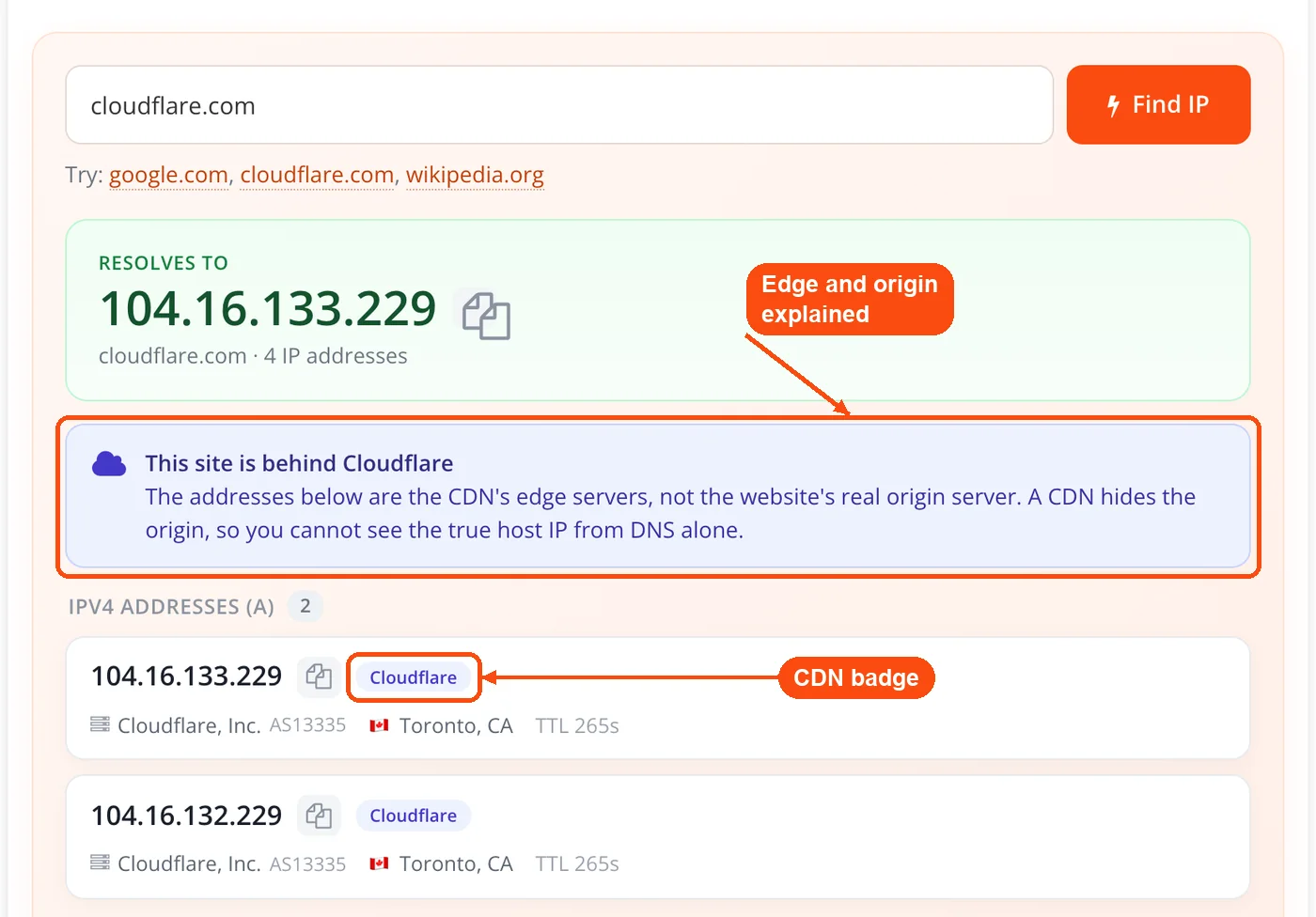
- Results render, then export. The primary IP, full IPv4 and IPv6 lists, CNAME chain and explainers appear on screen, ready to copy or download as CSV or JSON.
Reading Your Results
The most common source of confusion is seeing a hosting company you have never dealt with. That usually means the domain is proxied. If the reverse DNS reads something like a Cloudflare or Akamai hostname and the ASN belongs to the same company, the addresses in front of you are edge nodes handling public traffic. The origin server is behind them and is not visible in DNS. This is deliberate, and it is the point of putting a proxy in front of a site.
Multiple addresses for one domain are normal rather than a fault. Round-robin DNS and anycast routing both publish several records so traffic spreads across machines or regions, which is why ToolsPivot lists them all instead of picking one. A different ordering on a second run does not mean anything is broken.
Reverse DNS deserves a caveat of its own. The PTR record is set by whoever controls the address block, not by the domain owner, so it tells you about the network the address belongs to rather than proving which site is served from it. Treat it as a strong hint. If you need to know whether the address is shared with other sites, the Class C IP checker looks at neighbours in the same block.
An empty result set usually points at the domain rather than the tool. Expired registration, a typo, or a record that has not propagated yet all produce nothing to resolve. A WHOIS lookup confirms whether the domain is registered and who holds it, and the domain age checker gives you the registration history alongside it.
When to Use a Domain to IP Lookup
Reach for this when you need to know what the public internet sees for a domain, and you need it for every address rather than one sample. That covers firewall work, migration checks, vendor vetting and incident triage.
- Building allow lists: Firewall rules take addresses, not names, and a partial list means intermittent blocking.
- Verifying a migration: Confirm the domain now resolves to the new host and check the TTL to judge how long stale answers will linger.
- Checking IPv6 readiness: Missing AAAA records explain why a site is unreachable for IPv6-only clients.
- Identifying a hosting stack: ASN and reverse DNS together usually reveal the provider behind an unfamiliar domain.
- Triaging an outage: Confirm the domain still resolves before assuming the server is down.
- Investigating a suspicious domain: Ownership and location give you something concrete to cross-reference.
- Auditing a domain portfolio: Bulk mode turns a list of domains into one table you can sort and export.
It is the wrong tool for one job: finding the real server behind a proxy. That address is hidden by design and no DNS query reveals it.
Practical Use Cases
Firewall Allow List for a New Vendor
Context: A SaaS vendor is approved and their API endpoint needs to reach your network. Resolve the vendor domain, take the complete IPv4 and IPv6 set rather than the first address, note the TTL so you know how often to re-check, and export the list as CSV to paste into the change ticket. The result is a rule that holds up when the vendor rotates between backends instead of one that fails at three in the morning. Before finalising, a quick blacklist lookup on those addresses is worth the minute it takes.
Confirming a Hosting Migration Landed
Context: A WordPress site has moved to a new host and support insists the change is live. Run the domain, compare the returned ASN and hosting organisation against the new provider, check whether any old addresses are still being served, and read the TTL to estimate remaining cache lifetime. If the addresses are correct but pages still look wrong, the HTTP header checker shows which server is actually answering, and the hosting checker confirms the provider independently.
Sizing Up a Competitor's Infrastructure
Context: You are benchmarking three competitors before a performance project. Resolve each domain, note which sit behind a CDN and which serve directly from a single region, and record the datacenter locations. A competitor on anycast edges will beat a single-origin site on latency regardless of page weight, which is context worth having before you read a page speed report. Bulk mode handles all three domains in one pass.
Triaging a Reported Outage
Context: Users report a site is unreachable and you need to separate a DNS problem from a server problem. If the lookup returns addresses normally, DNS is fine and the fault is downstream, which the server status checker and a ping test will narrow down. If it returns nothing, the problem is the records themselves. Ruling out DNS in the first thirty seconds saves you from debugging the wrong layer.
How This Compares to Other Domain to IP Converters
Some honesty is due here, because several free tools do parts of this well. Returning both A and AAAA records with TTL values is no longer unusual. DNSChecker's domain IP lookup does exactly that, including the server owner and a download option, and several bulk DNS tools export CSV and JSON without an account.
The real gap is narrower and more specific: enrichment usually applies to one address, not all of them. Tools that resolve a domain typically run reverse DNS and network context against the first IPv4 only, leaving the rest of the record set as bare numbers. Tools that do enrich thoroughly tend to require raw IP addresses as input and reject domains outright, which means resolving first in one tab and pasting addresses into another. Bulk DNS checkers return records without ownership data; bulk IP checkers return ownership data but will not resolve a domain for you.
That split is what ToolsPivot closes here. Every address the resolver returns gets its own reverse DNS, ASN, hosting organisation, location, TTL and CDN badge, in one view, from one input. The CDN caveat is not unique either. What differs is where it appears: attached to the specific addresses it applies to, rather than buried in a footnote.
Limitations You Should Know
- A CDN hides the origin, and this tool will not find it. When addresses belong to an edge network, the real server stays hidden. The tool labels the edge clearly rather than implying you are looking at the origin.
- Geolocation is approximate. The location shown maps to a datacenter or address block registration, not to a person or a company head office. City-level accuracy varies a lot by provider.
- Reverse DNS is a hint, not proof. PTR records are set by the address block owner and are not verified against the domain you looked up.
- Resolution happens from one location. Anycast and geo-routed domains can return different addresses elsewhere in the world, so results reflect one vantage point rather than a global view.
- Results are cached briefly. Repeating a lookup immediately after a DNS change may return the previous answer for a short window.
- Only A, AAAA and CNAME are covered. Mail, nameserver and text records need a full DNS query, and certificate details need an SSL checker.
Frequently Asked Questions
It queries DNS for the address records published under a domain and returns them. Specifically it reads A records for IPv4 and AAAA records for IPv6, along with the TTL attached to each one. Everything else, such as ownership and location, comes from separate databases keyed on the returned addresses.
Type the domain into the box above and press Find IP. The tool queries DNS for the A and AAAA records and lists the public IPv4 and IPv6 addresses it finds, each with its TTL. On your own computer, the nslookup or dig command does the same lookup against a single resolver.
Because large sites publish more than one address on purpose. Round-robin DNS spreads visitors across multiple servers, anycast announces the same address from many locations, and dual-stack sites publish both IPv4 and IPv6 records. Seeing five or six addresses for a busy domain is normal.
Yes. AAAA records are queried alongside A records and shown in their own list, each with reverse DNS, hosting owner, location and TTL. An empty IPv6 list means the domain has not published AAAA records, which is worth knowing on its own.
No, and no DNS lookup can. When a domain is proxied, the addresses published in DNS belong to the proxy network and the origin is never exposed there. ToolsPivot detects the CDN and says so rather than presenting edge addresses as if they were the origin.
Reverse DNS is the PTR record that maps an address back to a hostname. It is set by whoever controls the address block, usually the hosting company, so it indicates the network rather than proving which website is served. Treat it as a useful hint that often names the provider outright.
TTL is how many seconds resolvers are told to cache a record before checking again. A low TTL such as 300 means changes propagate within about five minutes, while 86400 means a full day of stale answers is possible. Check it before and after any migration.
Because the location describes the datacenter, not the business. A company in Manchester might serve traffic from Virginia or Frankfurt because that is where their host has capacity. Location data is also approximate and should not be used as evidence of anything on its own.
Yes, bulk mode is a bulk domain to IP lookup: it accepts a list of domains and returns them in one compact table. Results can be copied or exported as CSV or JSON. This is the fastest way to audit a portfolio or compare several competitors in a single pass.
No, enter the bare domain such as example.com. DNS resolution works at the hostname level, so protocols and paths are unnecessary. Note that www.example.com and example.com are technically different hostnames and can resolve differently.
Yes. This tool covers address records and the CNAME chain, then enriches each address with ownership and location data. A full DNS query returns every record type including MX, NS, TXT and SOA but does not tell you who owns the resulting addresses or where they sit.
Yes. Address records are published in public DNS and every browser retrieves them to load a page. Knowing an address grants no access to a server, since security depends on server configuration rather than on the address being secret.
That is a different question, since it concerns your network rather than a domain. The My IP Address tool shows the public address your connection presents, and the bulk geo IP locator handles enrichment when you already have a list of addresses.


