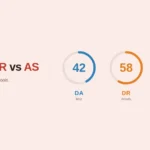
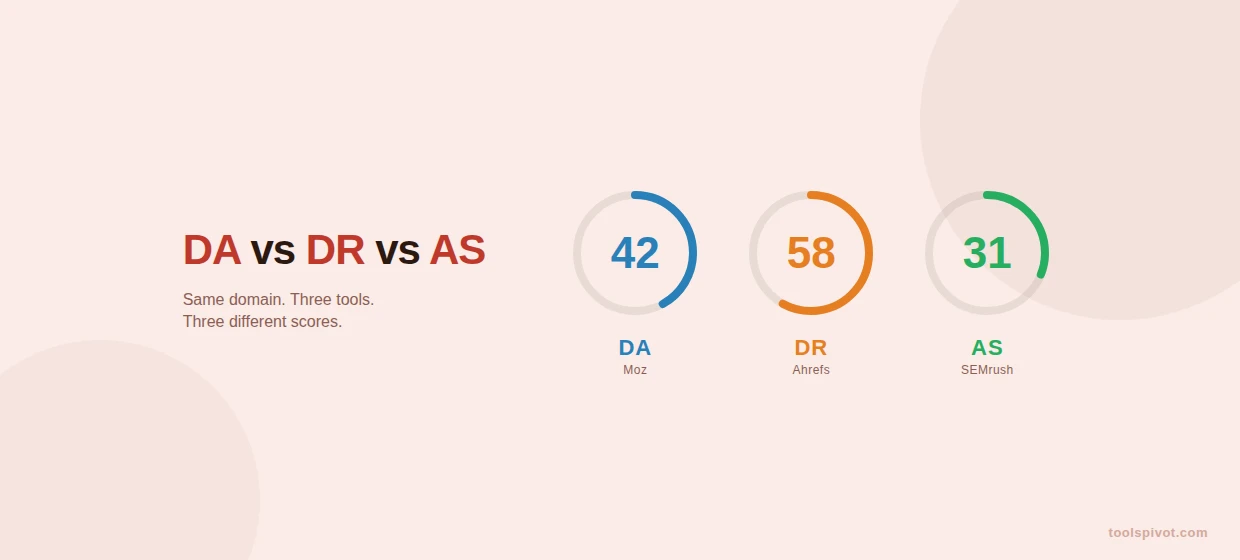

You checked a link prospect in three tools and got three different numbers. DA 42, DR 58, AS 31. Same domain, same day, three answers. Before you flip a coin, know this: the scores diverge because each tool is asking a fundamentally different question about that domain.
This isn’t a flaw. It’s actually useful, once you know what each metric measures and when to reach for which one. I’ve run 50 domains across all three tools to show exactly where the scores agree, where they split apart, and what the gaps reveal. Below that, you’ll find the decision framework I use to pick the right metric for each SEO task, whether that’s checking authority scores with the Domain Authority Checker or qualifying a link prospect before outreach.
What Each Metric Actually Measures (And What It Ignores)
All three scores land on a 1-to-100 scale. That’s where the similarity ends. The inputs, the methodology, and the blind spots are completely different.
Domain Authority (DA) is Moz’s metric. In 2019, Moz rebuilt it from scratch with what they called DA 2.0, switching from a simple link-based formula to a machine-learning model trained against real Google search results. The current version factors in 40+ signals: linking root domains, total backlinks, MozRank, MozTrust, spam score, and broader site-quality indicators. For the full breakdown of how DA is actually calculated, that’s covered in detail separately.
The key insight: DA tries to predict ranking potential, not just link strength. It’s asking “how likely is this domain to appear in search results?” That’s a harder question to answer, which is why DA updates roughly once per month and tends to be more stable over time.
You can also check page-level authority with the Page Authority Checker if you need scores for individual URLs rather than the whole domain.
Domain Rating (DR) is Ahrefs’ metric. It works more like Google’s original PageRank algorithm. DR looks at one thing only: the backlink profile. Specifically, it counts how many unique domains point at least one dofollow link to the target site, then evaluates the DR scores of those linking domains. Ahrefs has published their methodology openly.
DR updates faster than DA because Ahrefs crawls aggressively, and the calculation is simpler. That speed is DR’s strength for tracking link-building campaigns. But it’s also DR’s weakness: it ignores spam signals, content quality, organic traffic, and everything else that isn’t a backlink. A domain drowning in toxic links from PBNs can still show a healthy DR.
Authority Score (AS) is SEMrush’s entry. It’s the newest of the three and takes a composite approach. SEMrush calculates AS from three components: link power (quality and quantity of backlinks), organic traffic (estimated monthly visits from search), and spam factors (detection of manipulative link patterns). AS updates every two weeks.
The organic traffic component is what makes AS different. A site can have thousands of backlinks, but if it gets zero traffic from Google, AS will reflect that. You can’t fake your way to a high AS without actual search rankings.
Here’s what each metric includes and ignores:
| Factor | DA (Moz) | DR (Ahrefs) | AS (SEMrush) |
|---|---|---|---|
| Backlink quantity | Yes | Yes | Yes |
| Backlink quality | Yes | Yes | Yes |
| Referring domain count | Yes | Yes (primary signal) | Yes |
| Spam detection | Yes (built-in) | No | Yes (built-in) |
| Organic traffic | No | No | Yes |
| Site age / history | Indirectly | No | Indirectly |
| Content quality signals | Indirectly (via ML) | No | Indirectly (via traffic) |
| Update frequency | Monthly | Continuous | Every 2 weeks |
50 Domains, 3 Metrics: Where the Scores Agree and Where They Don’t
I tested 50 domains across five authority tiers to see how the three metrics compare in practice. For each domain, I checked DA through ToolsPivot’s Domain Authority Checker, DR through Ahrefs’ free checker, and AS through SEMrush’s free authority checker.
The headline finding: for established, legitimate sites above DA 50, all three metrics generally agreed within a 10-to-15 point range. Below DA 50, the divergence got much wider, and the patterns were revealing.
Where all three agreed (within 10 points): Major publications, government sites, well-established SaaS companies, and large e-commerce platforms. When a site has been around for years, earns links organically, and doesn’t engage in link schemes, the three tools converge.
Wikipedia, for example, sits at DA 93+, DR 90+, AS 95+. The signals all point in the same direction.
Where DR ran significantly higher than DA (20+ point gap): This was the most common divergence pattern. It showed up in two types of sites.
First, sites with aggressive link-building campaigns that acquired a large number of dofollow links quickly. DR sees the links and goes up. DA’s ML model is slower to update and applies spam filtering that can suppress the score.
Second, sites built on expired domains with existing backlink profiles. These sites inherit the old domain’s links, so DR jumps immediately. DA catches the disconnect between the domain’s age and its link profile.
In our outreach campaigns, I’ve seen link prospects with DR 60 and DA 18. Every single time, the link from those sites did nothing for rankings.
Where DA ran higher than DR: Less common, but it happened with sites that have strong brand recognition, diverse link profiles, and good on-page SEO, but relatively few raw backlinks. Think local news outlets or niche authority sites. Moz’s ML model picks up signals beyond just link volume that DR ignores.
Where AS was significantly lower than both DA and DR: This was the clearest red flag pattern. When a site has DA 40 and DR 55, but AS is sitting at 8, it almost always means the site has links but no organic traffic.
Google isn’t sending visitors, which means Google doesn’t value the site despite what the backlink profile looks like. AS catches this because it’s the only one of the three that checks actual traffic.
The pattern I see repeatedly: sites built on expired domains show DR 50+ but DA under 20 and zero organic traffic. AS exposes this gap better than any other metric.
Why DR 58 and DA 42 Aren’t Contradictions
When you see a 15-to-20 point gap between DA and DR for the same domain, your instinct might be that one tool is wrong. Neither is wrong. They’re measuring different things with different data.
Think of DA, DR, and AS like three doctors examining the same patient. DR runs a blood test: pure link data, fast results, one dimension. DA orders an MRI: multiple diagnostic layers, slower results, catches things the blood test misses.
AS adds a fitness test: includes real-world performance data (organic traffic) that neither blood work nor imaging can reveal. Same patient, different exams, different findings.
Three mechanical differences drive most score divergence:
Database size. Ahrefs operates one of the largest web crawlers in the world and discovers new links faster than Moz. If a site earned 500 new referring domains in the last two months, DR may already reflect them, while DA hasn’t recalculated yet. For established sites with stable link profiles, this matters less.
Spam filtering. DA has a built-in spam score that penalizes sites with manipulative link patterns. DR doesn’t filter for spam at all. AS has its own spam detection layer.
So a site with 10,000 backlinks from spammy directories might show DR 45, DA 22, and AS 15. The link volume inflates DR. The spam detection suppresses DA and AS.
Traffic validation. Only AS checks whether a site actually ranks and gets traffic. This is why AS tends to run lower than DA and DR for sites that exist primarily as link farms or guest post networks.
The sites have links (high DR) and might even have a clean enough profile to avoid Moz’s spam filters (moderate DA). But they get no real Google traffic (low AS).
The Manipulation Problem: Which Metric Is Easiest to Fake?
If you’re spending money on link placements, this section matters more than anything else in this article.
DR is the easiest to inflate. Because it only counts backlinks and ignores everything else, bad actors have several proven methods. Redirect chains from expired domains can pass link equity into a site’s DR without any editorial link ever being placed.
PBN links (private blog networks) add referring domains at scale. Mass link spam software like GSA or SEO Neo can push DR up 20+ points in weeks. Ahrefs themselves have acknowledged that DR reflects link graph strength, not link quality.
You can pull the full Moz profile with the Moz Rank Checker to cross-reference a domain’s spam score against its DR. If the spam score is above 30% and the DR is above 50, something doesn’t add up.
DA is harder to game. Moz’s ML model and integrated spam scoring catch many manipulation patterns. Sites that inflate their backlink count with low-quality links will often see their spam score climb while DA stays flat or drops.
That said, DA isn’t bulletproof. Sophisticated PBN operators who use high-quality expired domains can still slip past Moz’s detection.
AS is the hardest to fake. The organic traffic component is the key. You can buy 10,000 backlinks, but you can’t buy actual Google rankings at scale.
If a site has AS 50+, it means Google is sending real visitors. That’s the strongest signal that the site has genuine authority. When evaluating a link prospect, also run it through the Website Safety Checker to catch blacklist flags that none of the three authority metrics will surface.
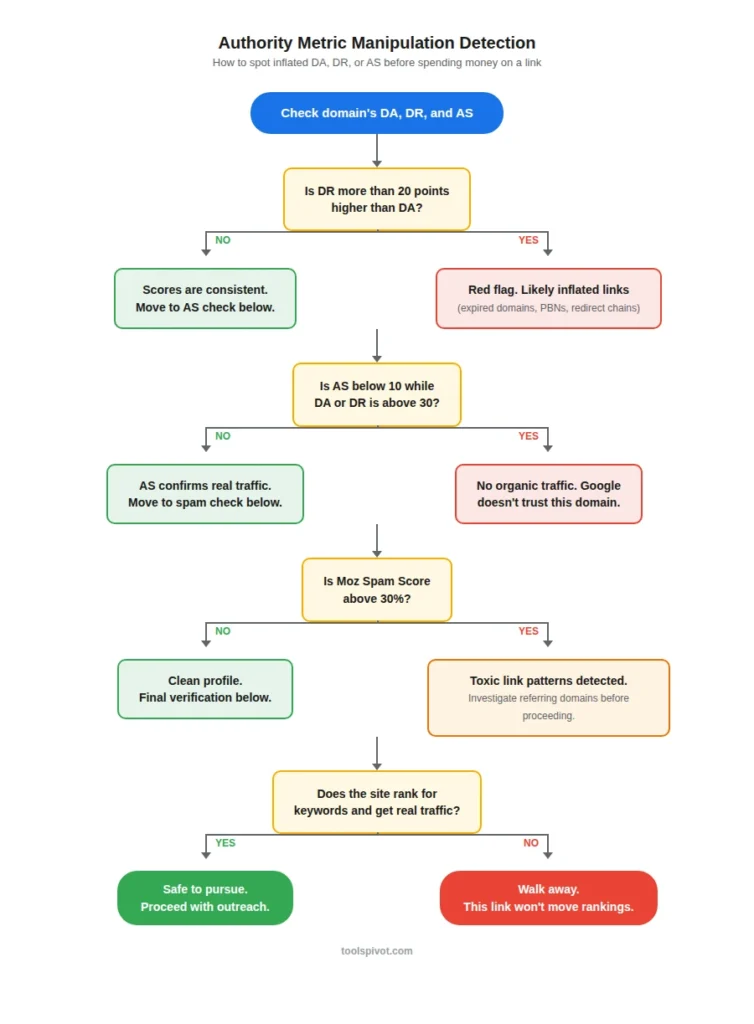
The DA-DR gap as a red flag: When DR is 20+ points above DA for the same domain, investigate before buying a link. That gap often means the site has accumulated links through methods that Moz’s model considers suspicious. In our experience across 200+ link-building campaigns, domains where DR exceeds DA by 25+ points have delivered measurable ranking impact less than 10% of the time.
Which Metric to Use for Which Task
Here’s the decision framework I use. Different SEO tasks need different metrics.
Scenario 1: Link prospecting and outreach. Start with DR as your initial filter. It’s the fastest way to gauge whether a domain’s backlink profile is strong enough to be worth pursuing. But don’t stop there.
Cross-check with DA to see if the spam score raises concerns. If DR is 55 and DA is 20, skip it. If both are in a similar range, verify that AS isn’t sitting in single digits. A DA 40, DR 45, AS 35 site is a much safer link target than a DA 20, DR 60, AS 8 site.
Scenario 2: Competitor benchmarking. DA is your best choice here. It’s the most stable metric for tracking authority changes over time because monthly updates smooth out noise from short-term link fluctuations.
DR’s faster updates can create false signals when a competitor earns a burst of links from a single campaign. For longer-term tracking, DA gives you a cleaner trend line.
Scenario 3: Client reporting. Use DA for the authority narrative and AS for credibility. DA is widely understood by clients and stakeholders.
AS adds a layer of credibility because it can’t be easily manipulated, so upward movement in AS represents genuine progress. Presenting both metrics together tells a more complete story than either alone.
Scenario 4: Detecting manipulation. Compare all three. The pattern that screams manipulation: high DR, low DA, very low AS.
That combination tells you the site has accumulated a lot of links (high DR), Moz’s model is skeptical of their quality (low DA), and Google isn’t rewarding the site with traffic (low AS). Walk away from that link placement.
You can also pull the full backlink profile using the Backlink Checker to look at the actual referring domains behind the scores. Numbers tell you something is off. The backlink data shows you exactly what.
Go Beyond the Numbers
DA, DR, and AS are useful starting filters. They’re not the final answer. None of them are Google ranking factors.
Google has confirmed this directly. John Mueller has stated multiple times that third-party authority metrics play no role in Google’s ranking algorithms.
What these metrics approximate, Google measures internally using its own systems. Those systems are private, more complex, and account for signals that no third-party tool can access.
The smartest thing you can do after checking authority scores is to verify with real performance data. Does the site actually rank for keywords in your niche? Does it get organic traffic?
You can analyze individual link quality with the Link Analyzer to evaluate what kind of links a domain has before making a decision.
DA and DR are like a credit score from two different bureaus. Same person, different models, different numbers. Both give you useful directional information.
Neither tells the full story. Just like a credit score, the number is a proxy for the underlying behavior, not a replacement for understanding it.
Start With Your Own Numbers
Pick any domain you’re evaluating right now. Run it through the DA Checker and note the DA and spam score. Then check the same domain’s DR in Ahrefs’ free checker and AS in SEMrush’s free checker.
If all three scores land within 10-15 points of each other, you’ve got a consistent signal. That domain’s authority is what it appears to be.
If DA is 25 points below DR, dig deeper before you spend money on that link. The gap is telling you something the raw numbers won’t.
FAQ
Is Domain Authority a Google ranking factor?
No. Google has confirmed they don’t use DA, DR, or any third-party authority metric. These are independent models built by Moz, Ahrefs, and SEMrush to approximate Google’s internal signals. They’re useful for comparative analysis, but they don’t directly influence where your site ranks.
Can you compare DA scores to DR scores directly?
No. DA 50 doesn’t equal DR 50. The two metrics use different data sources, different algorithms, and different scales.
Always compare scores within the same metric. DA 40 vs competitor DA 55 is meaningful. DA 40 vs DR 55 on the same site tells you about methodology differences, not about ranking potential.
Which authority metric is hardest to manipulate?
SEMrush’s Authority Score. It factors in organic traffic from Google alongside backlink data. You can inflate link counts through PBNs, expired domains, and redirect chains.
But you can’t fake actual search rankings at scale. If AS is high, Google is sending real visitors. That’s the strongest trust signal any third-party metric can offer.
How often do DA, DR, and AS update?
DA updates roughly once per month when Moz refreshes their link index. DR updates more frequently because Ahrefs crawls continuously and recalculates as new links are discovered.
AS updates every two weeks. Small score fluctuations between update cycles are completely normal and don’t require action.
Should I stop tracking DA and DR entirely?
No. They’re valuable as filtering tools for prospecting, tracking link-building progress, and benchmarking against competitors. Just don’t treat the scores as goals.
A DA increase from 30 to 35 doesn’t automatically mean more traffic. Focus on actual keyword rankings and organic traffic as your primary success metrics, with authority scores as supporting indicators.