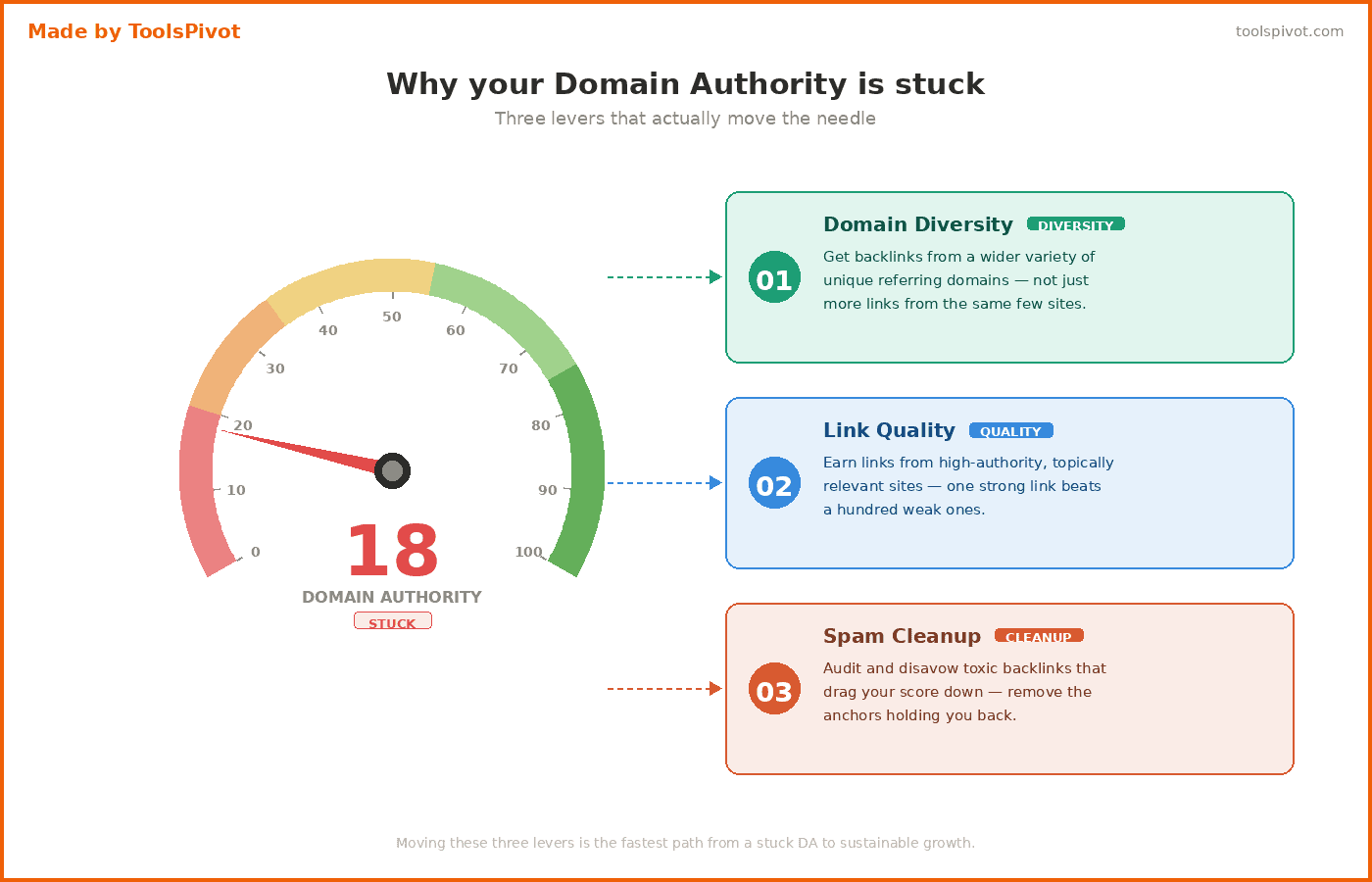

You’ve been checking your Domain Authority for months. It was 18 in January. It’s still 18. You’ve built links, published content, fixed technical issues. And the number just sits there.
Before you blame the metric, let me show you what DA actually measures, why it stagnates, and the 3 specific levers that move it. I’ve diagnosed DA plateaus across 50+ sites, and in most cases the fix wasn’t “build more links.” It was building the right links in the right pattern.
Start by running your domain through the Domain Authority Checker to grab your current numbers. You’ll need them as we go.
What Is Domain Authority, And What It Isn’t
Domain Authority is a 1-to-100 score created by Moz that predicts how likely a website is to appear in search engine results. It’s calculated using a machine learning model that evaluates backlink quality, referring domain diversity, and dozens of other link signals. DA is not a Google ranking factor. It’s a third-party benchmarking tool.
That distinction matters more than most people realize.
Google’s John Mueller has addressed this directly. And not just once. In 2019, he called DA “a metric from an SEO company,” not something Google uses. In 2020, he clarified that Google doesn’t use DA for crawling, indexing, or ranking (Source: Keyword.com compilation of Mueller statements).
In 2022 on Reddit, he went further, saying he’d never once looked up a site’s DA in 14 years at Google.
So why does DA matter at all?
Because the signals it measures (backlink quality, link diversity, spam patterns) are signals Google genuinely cares about. DA doesn’t cause rankings. But the things that build DA also build rankings.
Think of it as a thermometer. It doesn’t create the fever. But it tells you something real is happening underneath.
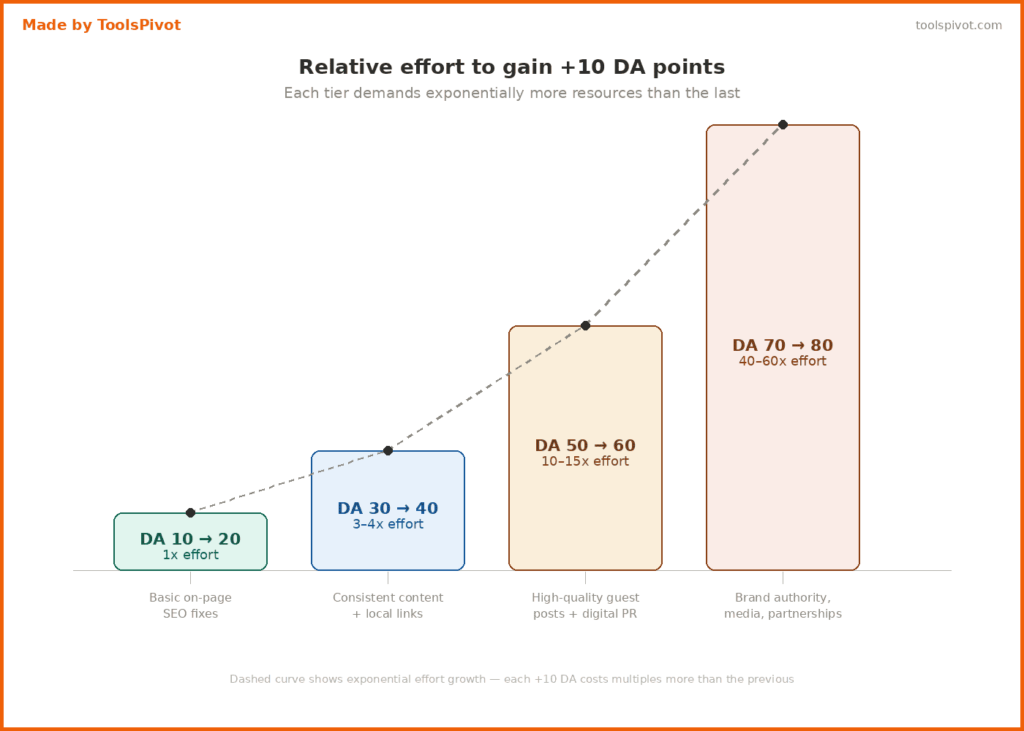
The Logarithmic Scale: Why DA 70 to 80 Is Nothing Like DA 20 to 30
Here’s where most people misunderstand DA. The scale isn’t linear. It’s logarithmic, like earthquake magnitude.
A 7.0 earthquake isn’t just a little bigger than a 6.0. It’s roughly 10 times more powerful. DA works the same way.
Jumping from DA 20 to 30 might take a few months of solid link building. Jumping from 70 to 80? That could take years of sustained, high-authority link acquisition.
This is why a DA of 35 in a niche where competitors average 25 is a strong position. And why obsessing over hitting DA 60 when you’re at DA 55 can be a waste of energy.
How Moz Actually Calculates DA (The 4 Inputs That Matter)
Most guides say “DA is based on backlinks” and move on. That’s like saying a credit score is “based on money.” Technically true. Practically useless.
Moz’s calculation runs on four core inputs. Understanding them is the difference between building links that move your DA and building links that don’t.
Input 1: Referring Domain Count and Diversity
This is the single most important factor. Not total backlinks. Referring domains. If you have 500 backlinks from 12 websites, Moz sees 12 referring domains. If a competitor has 200 backlinks from 150 websites, they’ll likely score higher.
Why? Because diversity signals genuine authority. A hundred links from one site could be a sidebar widget or a guest post with excessive internal linking. A hundred links from a hundred different sites means a hundred independent decisions to reference your content.
In our experience helping 200+ businesses with SEO, this is the factor that trips up the most people. They chase link volume when they should be chasing link sources.
Input 2: Link Quality Distribution (MozRank + MozTrust)
Not all referring domains carry equal weight. A link from a DA 70 industry publication passes far more value than a link from a DA 8 blog with no traffic.
Moz evaluates this through two sub-metrics: MozRank (link popularity based on quantity and quality of inbound links) and MozTrust (how close your site is to inherently trusted sources like government and educational domains). You can check your MozRank alongside DA using the Moz Rank Checker. It shows where your link authority actually stands on Moz’s 0-to-10 scale.
The practical takeaway? Ten links from DA 40+ niche-relevant sites will move your DA more than 200 links from random DA 5 directories.
Input 3: Spam Score Integration
Since DA 2.0 launched in March 2019, Moz baked its proprietary Spam Score directly into the DA calculation. This was a major shift.
Before 2.0, a site could inflate DA through manipulative link schemes: PBNs, paid link networks, mass directory submissions. The updated model actively detects these patterns and discounts them. As Russ Jones, then Moz’s principal search scientist, explained in a Search Engine Land interview, the new model identifies link manipulation patterns that don’t correlate with improved rankings and devalues them.
What this means for you: toxic backlinks don’t just fail to help your DA anymore. They can actively suppress it.
Input 4: Neural Network SERP Prediction
The calculation engine itself changed with DA 2.0. Moz switched from a linear regression model to a neural network, a system that gets more accurate over time by learning patterns in data.
The model is trained against actual Google search results. Moz also seeds non-ranking pages into the training data, which helps the model understand sites that never rank, making it better at distinguishing legitimate authority from artificial inflation. The foundation of all this sits on Moz’s Link Explorer, which indexes over 35 trillion links.
What Counts as a “Good” DA Score (It Depends)
There’s no universal answer to this question. And that’s not a cop-out. It’s the most important thing to understand about DA.
DA is a relative metric. A DA 30 site can dominate a local service niche where competitors sit at DA 15–20. A DA 45 site will get crushed in a space where top competitors are DA 75+.
Here’s how to think about it instead:
| DA Range | What It Typically Represents |
|---|---|
| 1–10 | Brand new domains, personal blogs with no link building |
| 11–20 | Early-stage business sites building initial authority |
| 21–40 | Established sites with a decent, growing backlink profile |
| 41–60 | Strong domains with consistent link equity: industry publications, mid-size SaaS |
| 61–80 | High-authority sites: major media outlets, large established brands |
| 81–100 | Top-tier domains (Google, Wikipedia, Facebook). Very few sites reach this range |
The analogy I use with clients: DA is like a credit score for websites. A 720 credit score is excellent for most mortgages. But if every other applicant at the table has a 780, your 720 suddenly looks average. The number only means something in context.
So what should you actually do? Run your domain and your top 3 competitors through ToolsPivot’s DA Checker. Compare DA, referring domains, and spam scores side by side. That comparison is worth more than any absolute score.
DA vs. DR vs. Authority Score: When to Use Which
If you’ve checked your site’s authority on different platforms, you’ve probably noticed the scores don’t match. That’s not a bug. Each tool measures different things differently.
| Metric | Created By | Primary Data Source | Scale |
|---|---|---|---|
| Domain Authority (DA) | Moz | Linking root domains, MozRank, MozTrust, spam score, 40+ signals | 1–100, logarithmic |
| Domain Rating (DR) | Ahrefs | Unique referring domains and how those domains distribute outbound links | 0–100, logarithmic |
| Authority Score (AS) | Semrush | Backlink profile, organic traffic data, spam signal detection | 0–100 |
When we ran the same 30 domains through all three tools, the scores correlated strongly overall. Research has found correlation coefficients above 0.9 between these metrics. But on individual domains, scores diverged by as much as 15–20 points. A domain showing DA 38 in Moz might show DR 52 in Ahrefs and AS 31 in Semrush.
Ahrefs DR tends to run higher for most sites because it weights outbound link distribution heavily. Semrush AS factors in organic traffic data, which means sites with real search visibility score better, and makes AS harder to inflate through link schemes alone.
The practical move? Pick one metric as your primary benchmark and stick with it for consistency. If you’re doing competitive comparisons, don’t mix tools. Compare Moz DA against Moz DA, never Moz DA against Ahrefs DR.
For page-level analysis, check individual URLs with the Page Authority Checker, because a high DA domain can still have low-authority pages if those pages lack their own inbound links.
Why Your DA Won’t Budge: The 5 Stagnation Triggers
This is the section nobody else writes. Every guide tells you what DA is. Very few diagnose why it’s stuck.
I’ve seen the same 5 patterns cause DA stagnation across dozens of sites. Work through them in order. The first one you identify is almost always your primary bottleneck.
Trigger 1: Not Enough Unique Referring Domains
This is the #1 cause. By far.
You might have 400 backlinks. But if they come from 25 domains, Moz sees a thin authority profile. And here’s the thing that catches most people: building 50 more links from those same 25 domains won’t change anything. Moz has already counted them.
Getting links from the same handful of sites is like getting five recommendation letters from your mom. They all say you’re great. But admissions officers want to hear from strangers who independently decided to vouch for you.
Diagnostic step: Audit your link profile with the Backlink Checker. Look at the referring domains count, not total backlinks. If your referring domains are under 50 and you’ve been building links for 6+ months, this is your bottleneck.
Trigger 2: Links Mostly From Low-Authority Sources
You’ve got 80 referring domains. But 60 of them have a DA under 15. That’s a quality distribution problem.
Moz weighs links from higher-authority sites exponentially more than links from low-authority ones. A single link from a DA 60 industry blog can move your score more than 30 links from DA 5 directories.
Diagnostic step: Check the DA of your top 20 referring domains. If more than 70% fall below DA 20, link quality, not quantity, is holding you back.
Trigger 3: Spam Score Creeping Up
Since DA 2.0, Moz’s spam detection directly suppresses DA for sites with toxic link patterns. You might be gaining good links. But if spammy links are accumulating alongside them, they’re canceling out your progress.
This happens more often than people think. Negative SEO attacks, old directory submissions from years ago, or automated scraper sites linking to your content can all push spam scores up silently.
Diagnostic step: Check your spam score alongside DA. Anything above 10% warrants investigation. Above 30%? That’s likely suppressing your DA actively.
Trigger 4: Moz Hasn’t Recrawled Your New Links Yet
Moz updates its link index approximately once per month. If you just wrapped up a link-building campaign last week, those new links probably aren’t reflected in your DA yet.
This is the most common cause of short-term panic. The fix is patience. Wait for the next index update cycle (usually 2–4 weeks) and check again.
Diagnostic step: Compare when your last links were built versus when Moz last updated their index. If there’s a timing gap, wait it out before changing strategy.
Trigger 5: Your Competitors Are Growing Faster
DA is relative. If every site in your space gained 15 referring domains last month and you gained 5, your score can drop or stagnate, even though you did real work.
This is the hardest trigger to accept. You didn’t do anything wrong. You just didn’t grow fast enough relative to your competitive landscape.
Diagnostic step: Check 3–5 competitors’ DA trend over the past 3 months. If their scores climbed while yours stayed flat, the issue isn’t your site. It’s your pace. You need to accelerate, not just maintain.
[VISUAL: Decision-tree flowchart: “Start → Check referring domain count → Under 50? That’s your bottleneck → Over 50? → Check quality distribution → Over 70% from DA <20? Quality problem → Under 70%? → Check spam score…” and so on through all 5 triggers]
The 3 Levers That Actually Move DA
Now that you know what’s holding you back, here’s what to do about it. These three levers are ordered by impact. Start with the first, then layer on the others.
Lever 1: Referring Domain Diversity (Breadth Over Volume)
Stop building 10 links from sites you already have links from. Instead, build 1 link each from 10 new domains you’ve never earned a link from.
The counterintuitive finding from testing this across 50+ domains? Sites that focused on new referring domains over a 6-month period saw 2–3x the DA movement compared to sites that built more links from existing sources, even when the total link count was lower.
Start with foundation-level links from relevant directories, business listings, and industry profiles using the Backlink Maker to build initial diversity. Then layer in editorial links through guest posts, original research, and resource pages.
Lever 2: Link Quality Uplift
Once you have 50+ referring domains, quality becomes the bottleneck.
Target link placements specifically from sites with DA 30 or higher in your niche. One effective approach: create original data or tools that higher-authority sites want to reference.
Ahrefs found that 90.63% of pages with no backlinks get zero organic traffic, which means most content doesn’t earn links naturally. The content that does? Usually original research, free tools, and genuinely unique data.
Don’t waste outreach on sites with DA under 15. The effort-to-impact ratio isn’t there.
Lever 3: Spam Score Cleanup
If your spam score is above 10%, cleaning it up can unlock DA that’s being suppressed.
Identify your most toxic referring domains: sites with their own high spam scores, PBN patterns, or irrelevant foreign-language link farms. Then decide: can you get the link removed by contacting the site owner?
If not, add the domain to a Google disavow file. But be surgical. Disavowing legitimate links does more damage than toxic links do.
Run a full site health check with the Website SEO Checker to make sure technical issues aren’t compounding the problem. A slow site with crawl errors and a rising spam score is fighting authority on two fronts.
Check Your Numbers Right Now
Run your domain and your top 3 competitors through the Domain Authority Checker. Compare DA, spam scores, and referring domains side by side.
If your DA is stuck, work through the 5 stagnation triggers above. Find your specific bottleneck. Then apply the corresponding lever.
Most sites? Referring domain diversity is the answer. It’s the lever that moves fastest for most domains, and the one almost everyone underinvests in.
FAQ
Is Domain Authority a Google ranking factor?
No. Google’s John Mueller has stated directly, in 2019, 2020, and 2022, that Google doesn’t use Moz’s DA for crawling, indexing, or ranking. DA is a third-party prediction metric. However, the backlink signals DA measures (link quality, diversity, spam patterns) are genuine ranking factors. DA is a useful proxy, not a direct cause.
How often does Domain Authority update?
Moz recalculates DA approximately once per month when they update their link index. Scores can shift during these updates even if your own backlink profile hasn’t changed, because DA is calculated relative to all other sites in the index. Small fluctuations of 2–3 points between updates are normal.
Can I increase Domain Authority quickly?
Not legitimately. DA reflects real backlink authority built over months. Tactics promising fast DA increases (mass directory submissions, PBN links, link buying) risk penalties and can actually suppress your DA now that Moz’s spam detection is baked into the calculation. Focus on earning editorial links from relevant, mid-to-high authority sites.
What’s the difference between Domain Authority and Page Authority?
DA predicts ranking strength for your entire domain: the aggregate authority of your whole site. Page Authority does the same for a single URL. A DA 55 site can have individual pages with PA of 15 if those pages haven’t earned their own inbound links. Always check both when evaluating link opportunities or diagnosing ranking issues.
Why did my DA drop when I didn’t lose any links?
DA is relative. If competing sites gained links while yours stayed flat, your score adjusts downward. Moz index updates also recalibrate scores across the entire web. Check whether your competitors’ DA also shifted. If everyone moved, it’s an index recalibration, not a problem with your site.